You flip the switch and nothing happens. Or worse — you hear a low hum but no grinding action. A garburator (garbage disposal) that suddenly stops working is one of the more frustrating kitchen surprises, especially mid-meal prep. The good news is that most garbage disposal problems are straightforward to diagnose and often fixable without a service call.
At Tri-City Repairs, we help homeowners across Coquitlam, Port Coquitlam, and Port Moody keep their kitchen appliances running well. This complete guide covers the most common garburator problems — and exactly how to fix them.
How a Garburator Works
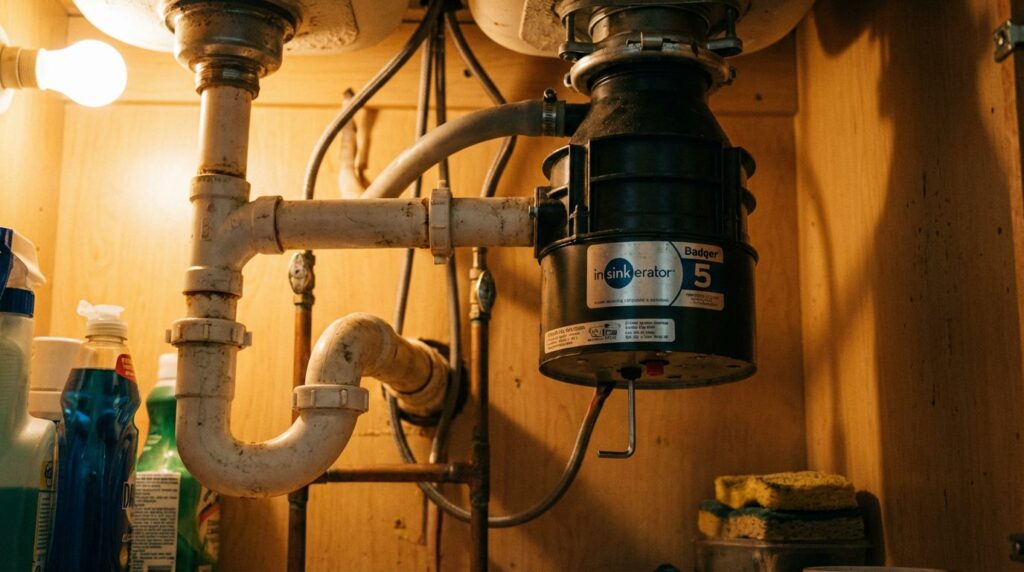
Despite the name, a garbage disposal doesn’t have sharp blades like a blender. Instead, it uses a spinning disc (impeller plate) with blunt lugs that fling food waste against a stationary grind ring. The resulting particles are small enough to wash away through the drain. An electric motor beneath the unit powers the spinning disc, and a reset button on the bottom provides safety protection if the motor overloads.
Understanding this helps you diagnose what’s wrong when it stops working.
Common Garburator Problems and How to Fix Them
Problem 1: Garburator Won’t Turn On (No Hum, No Sound)
If you flip the switch and hear absolutely nothing — no hum, no click — the unit has lost power. This almost always means one of three things:
a) The reset button has tripped. Every garburator has a thermal overload protector with a reset button on the bottom of the unit (look underneath the sink — it’s a small button, usually red). When the motor overloads from a jam or extended use, this button pops out automatically as a safety measure.
What to do: Make sure the disposal is off. Press the reset button in firmly until you feel it click. Turn the unit back on. If the reset was the issue, it should now work.
b) The wall switch has failed. Garbage disposal switches take a lot of use and can fail over time. If the reset button doesn’t help, test the switch by checking if power is reaching the disposal using a non-contact voltage tester. If the switch is faulty, it’s a quick and inexpensive replacement.
c) The circuit breaker has tripped. Check your electrical panel for a tripped breaker on the kitchen circuit. Reset it if needed.
Problem 2: Garburator Hums But Doesn’t Spin (Motor Running, Plate Jammed)
This is the most common garburator problem. When you hear a low hum but no grinding sound, the motor is receiving power but the spinning plate is jammed — stuck against something lodged in the grinding chamber. Left running in this state, the motor will overheat and trigger the reset button (or damage the motor).
What to do:
- Immediately turn off the disposal. Never put your hand in the unit.
- Locate the hex wrench port on the bottom centre of the unit (most disposals come with a small Allen/hex key for this purpose — often 1/4 inch).
- Insert the hex wrench and manually turn it back and forth. This frees the stuck impeller plate. You’ll feel resistance, then release as the jam clears.
- If you don’t have the hex wrench, try using a wooden broom handle inserted from the top (with power OFF) to gently push the impeller.
- Once freed, use tongs to remove the foreign object (never your hand).
- Press the reset button, wait 5–10 minutes for the motor to cool, then turn the disposal back on and run cold water through it.
Common jam culprits include fruit pits, hard seeds (like avocado), small bones, utensils, jar lids, and bottle caps. These items should never go into the disposal.
Problem 3: Garburator Works But Drains Slowly or Not At All
If the motor runs fine but water isn’t draining, the problem is a clog in the drain line rather than the disposal itself. Over time, grease, food residue, and soap can build up in the drain pipe that leads away from the disposal.
What to do:
- Pour half a cup of baking soda into the drain, followed by a cup of white vinegar. Let it fizz for 15 minutes.
- Flush with boiling water.
- If that doesn’t clear it, use a sink plunger directly over the drain opening with water in the sink.
- For persistent clogs, place a bucket under the P-trap (the curved pipe beneath the sink), remove it, and clear the blockage manually.
Mineral and grease buildup in drain lines is a common issue in many homes. The Effects of Mineral Buildup on Your Appliance Performance explains how these deposits accumulate over time and what you can do to manage them.
Problem 4: Garburator Is Leaking
Leaks from a garburator can come from several points:
- Sink flange (top): The mounting ring where the disposal connects to the sink drain. If the plumber’s putty that seals this joint dries out or the mounting hardware loosens, water leaks from the top. Tightening the mounting bolts or resealing with fresh putty usually fixes this.
- Dishwasher inlet hose (side): The small hose connecting your dishwasher to the disposal. Loosen and retighten the hose clamp if it’s leaking.
- Drain hose (bottom side): The pipe going to the drain. Ensure the slip joint nut is tight and the gasket is intact.
- Bottom of the unit: If the leak comes from the motor area at the very bottom, the internal seal has failed. At this point, replacement of the unit is usually more cost-effective than repair.
Problem 5: Garburator Makes Loud Grinding or Rattling Noise
Normal disposal operation produces a consistent grinding sound. If you’re hearing unusual rattling, clanging, or a higher-pitched grinding noise, something hard is likely in the chamber (a coin, a small stone, a piece of glass). Turn off the unit immediately and use tongs to inspect and remove the object.
If the noise persists after clearing any foreign objects, the grinding ring may be worn or the bearings in the motor may be failing — signs that the unit is nearing the end of its life.
What Never to Put in a Garburator
Preventing jams and clogs is far easier than clearing them. Avoid putting the following into your disposal:
- Hard pits and seeds (peach, avocado, cherry)
- Bones of any kind
- Fibrous vegetables (celery, artichokes, asparagus — strings wrap around the motor)
- Grease, oil, or fat
- Pasta, rice, or bread (expand with water and create thick paste clogs)
- Coffee grounds (accumulate in the drain trap over time)
- Eggshells (contrary to popular belief, they don’t sharpen blades — they create fine granular waste that clogs drains)
- Potato peels (become starchy paste that coats the impeller)
Maintenance Tips to Keep Your Garburator Running Well
- Always run cold water before, during, and for 30 seconds after using the disposal. Cold water solidifies fats so they grind up properly rather than coating the drain.
- Clean monthly with ice cubes and salt. Run a tray of ice cubes through the disposal with a handful of coarse salt — it scrubs the grinding components without damage.
- Deodorise with citrus. Run orange or lemon peels through occasionally to keep the unit fresh.
- Don’t overfeed it. Feed waste in gradually rather than pushing in large quantities all at once.
The best way to avoid a breakdown is consistent care. Many of the same principles that apply to garburators also apply to other kitchen appliances — our post on DIY vs Professional Appliance Repair: When to Call the Experts is a helpful read if you’re deciding when to tackle a repair yourself versus calling a technician.
When to Replace Rather Than Repair
Garburators typically last 8–15 years depending on use and maintenance. Signs it’s time for replacement rather than repair:
- Frequent jams even after clearing foreign objects (worn grinding components)
- Persistent leaking from the motor housing (failed internal seals)
- Constant reset button trips (failing motor)
- Age over 12 years combined with multiple issues
Replacement garburators are available at most hardware stores starting around $100–$150 for a basic model, up to $300+ for a premium quiet unit. Installation takes about an hour for a straightforward swap.
When to Call Tri-City Repairs
If you’ve tried the reset, cleared the jam, and your garburator still isn’t working — or if you’re dealing with a persistent leak or a unit that’s clearly at the end of its life — Tri-City Repairs can help. We install and repair garburators across Coquitlam, Port Coquitlam, and Port Moody, and can usually assess the situation and give you an honest recommendation on repair versus replacement on the same visit.
Call us at (604) 359-5952 or visit tricityrepairs.ca to book service.