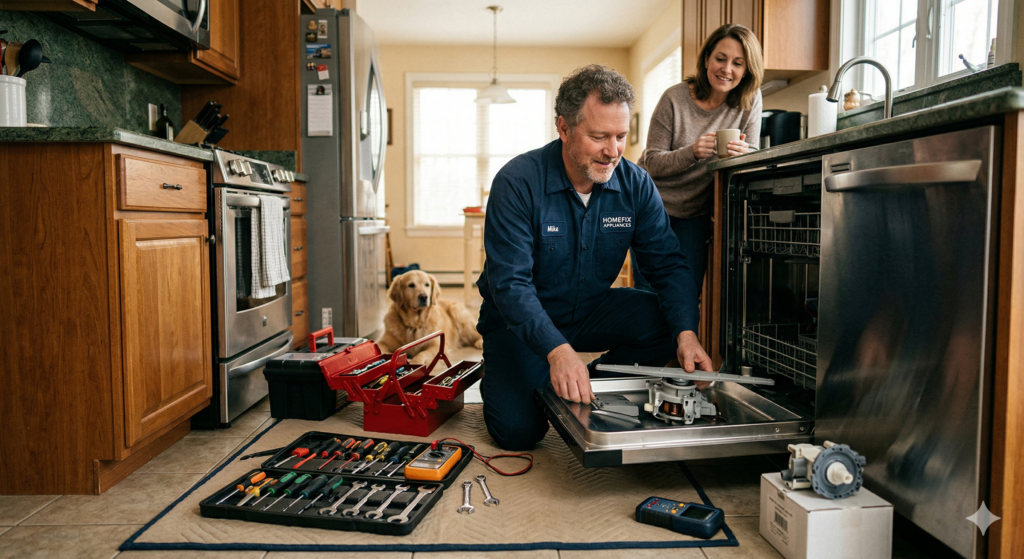
Something has gone wrong with one of your appliances, and you’re weighing your options. Do you roll up your sleeves and tackle it yourself, or do you pick up the phone and call a repair technician? It’s a question every homeowner faces, and the answer isn’t always obvious. Some appliance repairs are perfectly safe and satisfying to do yourself. Others involve real risks — to your safety, your appliance’s warranty, or the appliance itself.
This guide will help you make a smart, informed decision about when DIY is the right call and when professional repair is the wiser investment. If you’re in Coquitlam, Port Coquitlam, or Port Moody, Tricity Repairs is always here when you need us.
The Case for DIY Appliance Repair
DIY appliance repair has never been more accessible. Online parts retailers, manufacturer service manuals, and detailed video tutorials mean that motivated homeowners can successfully tackle many repairs that once required a technician. The potential benefits are real: cost savings on labour, the satisfaction of solving a problem yourself, and faster resolution when a technician’s schedule is backed up.
The key is knowing which repairs sit within the DIY zone and which ones don’t.
Repairs That Are Generally Safe to DIY
Cleaning and Maintenance Tasks
The vast majority of appliance maintenance is fair game for any homeowner:
- Cleaning refrigerator condenser coils — vacuum and brush accessible coils every 6–12 months.
- Cleaning dryer lint traps and vents — essential for fire prevention; clean the trap every load and the vent annually.
- Cleaning dishwasher filters and spray arms — monthly filter cleaning and periodic spray arm soaking in vinegar.
- Cleaning washing machine drum and dispensers — monthly cleaning cycles prevent odour and residue buildup.
- Levelling appliances — adjusting feet to stop vibration or rocking requires no tools beyond a wrench.
These maintenance tasks prevent the majority of common appliance problems and require no technical skill.
Simple Parts Replacement
Several straightforward part swaps are well within DIY territory for someone comfortable with basic tools:
- Refrigerator door gaskets — peel out the old seal and press or clip in the new one.
- Oven door gaskets — same principle as fridge seals.
- Dryer lint screen replacement — slides in and out in seconds.
- Refrigerator water filters — twist-off and replace, usually every 6 months.
- Dishwasher spray arms — unclip, soak in vinegar, or replace if cracked.
- Washing machine hoses — replacing rubber inlet hoses every 5 years prevents flooding; just turn off the supply valves first.
- Oven light bulbs — typically accessible through a covered socket inside the oven.
These repairs use inexpensive parts, require minimal disassembly, and carry very low risk of causing further damage. For more DIY maintenance tips, see: How to Maintain Your Washing Machine.
Resetting and Troubleshooting
Many modern appliance problems are software glitches or tripped safety mechanisms that resolve with a reset. Unplugging an appliance for 60 seconds and restarting, clearing error codes, and working through the manufacturer’s troubleshooting steps in the manual are all free, zero-risk first steps that often resolve the problem entirely. For a comprehensive guide, see: How to Reset Any Appliance.
When to Call a Professional
Any Electrical Work Inside the Appliance
This is the clearest line. Anything involving the internal wiring, control boards, capacitors, heating element wiring, or motor windings should be handled by a trained technician. The risks aren’t just to your appliance — working on live circuits or improperly reassembling electrical components can cause electrocution, fires, or appliance damage that far exceeds the original repair cost.
This includes: control board replacement, wiring harness repairs, motor replacement, and anything requiring you to probe internal electrical components. Even if you unplug the appliance, capacitors in some components can hold dangerous charges after being disconnected.
Refrigerant Handling
In Canada, handling, recharging, or recovering refrigerant in refrigerators, freezers, and air conditioners requires certification. It’s not legal for unlicensed individuals to perform this work, and attempting to do so can result in refrigerant release (environmentally harmful), voided warranties, and unsafe appliances. Any repair involving refrigerant — leak detection, recharging, compressor replacement — must be done by a certified technician.
Gas Appliance Repairs
Any work on gas lines, gas valves, igniters connected to the gas supply, or other components of a gas appliance should only be performed by a licensed technician. A gas leak is immediately life-threatening, and improper repairs can create hazards that aren’t apparent until the appliance is in use. Don’t attempt DIY repairs on gas ovens, ranges, or dryers beyond cleaning and surface-level maintenance.
When You Can’t Accurately Diagnose the Problem
Replacing parts based on guesswork is expensive and often ineffective. If you’ve run through the basic troubleshooting and can’t identify the root cause of the problem, a professional diagnosis is worth the service call fee. A technician with the right tools — multimeter, pressure gauges, diagnostic software — can pinpoint the issue accurately and often prevent you from spending money on parts that weren’t needed.
Warranty and Insurance Considerations
If your appliance is still under manufacturer warranty, DIY repairs may void the coverage. Check your warranty terms before opening up any appliance. Similarly, if an appliance repair goes wrong and causes water damage or a fire, an improper DIY repair may affect your home insurance claim. For appliances still under warranty or in a rental property, professional repair is almost always the right choice.
When Labour Would Exceed the Part Cost Significantly
Some repairs are technically within a motivated DIYer’s ability, but the disassembly required is extensive — requiring two to three hours of careful work. In these cases, paying a technician who can complete the job in 30–45 minutes due to experience may actually cost less than your time, especially if mistakes during reassembly lead to a second repair call.
A Practical Decision Framework
When deciding DIY or professional, ask yourself these questions:
- Is it a maintenance task or simple external part? → DIY is usually fine.
- Does it involve internal electrical components, gas, or refrigerant? → Call a professional.
- Can I accurately diagnose the problem? → If yes and the repair is straightforward, DIY may work. If unsure, call for a diagnosis.
- Is the appliance under warranty? → Check terms; lean professional.
- What’s the worst case if I get it wrong? → Bigger the downside, stronger the case for professional repair.
The Middle Ground: Getting a Diagnosis, Then Deciding
A useful strategy for appliances out of warranty: call a technician for the diagnosis only, get the part number and repair details, then decide whether you want to complete the repair yourself or have the technician do it. You pay for the expertise of accurate diagnosis while retaining the option to save on labour for simpler fixes.
Many Tri-Cities homeowners take this approach for things like washing machine lid lock replacement, dryer belt swaps, or oven igniter replacement — parts that are genuinely DIY-accessible once you know exactly what you need.
For guidance on whether repair is worth it at all given your appliance’s age, see: Repair vs. Replace: Appliance Cost Guide.
Tricity Repairs: Honest Advice for Tri-Cities Homeowners
At Tricity Repairs, we’ll always tell you honestly when a repair isn’t worth doing — and we’re happy to walk you through what’s wrong even if you decide to handle a straightforward repair yourself. Our goal is to help you make the best decision for your home and your appliances, not to upsell unnecessary service calls.
When you do need professional repair, we serve Coquitlam, Port Coquitlam, and Port Moody with fast, reliable service for refrigerators, washing machines, dryers, dishwashers, and ovens. Call us at (604) 359-5952 and we’ll give you a straight answer about what your appliance needs.
Summary
DIY appliance repair is a great option for maintenance tasks, simple part swaps, and resets — things that are low-risk and well-documented. Professional repair is the right call for anything involving internal electrical components, gas or refrigerant, complex diagnosis, or warranty-covered appliances. When in doubt, a professional diagnosis gives you accurate information to make the right decision — and often saves money compared to guessing your way through part replacements.