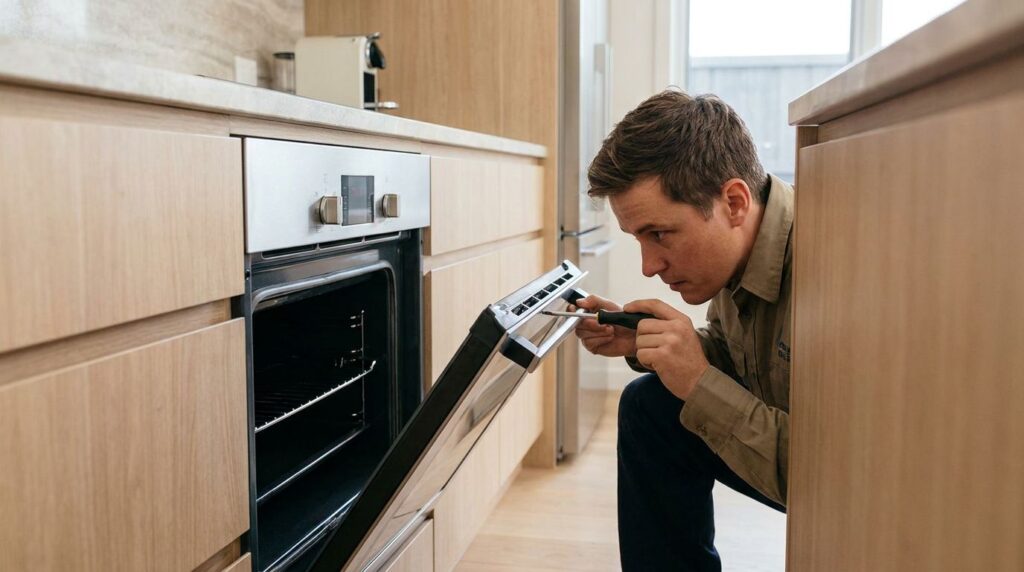
An oven door that won’t close all the way is more than just an annoyance — it’s an energy waster, a safety concern, and a sign that something inside your oven needs attention. Whether the door hangs open slightly, seals unevenly, or springs back when you try to close it, the underlying causes are usually identifiable and often fixable without replacing the whole appliance.
This guide covers the most common reasons an oven door won’t close properly, how to diagnose the issue yourself, and when to call in a professional. If you’re in Coquitlam, Port Coquitlam, or Port Moody, Tricity Repairs is here to help.
Why a Properly Closing Oven Door Matters
Your oven is designed to operate as a sealed chamber. When the door doesn’t close fully, several problems follow:
- Heat loss: Even a small gap allows significant heat to escape, forcing the oven to cycle more frequently to maintain temperature.
- Uneven cooking: Temperature fluctuations mean food cooks inconsistently — browned on top but undercooked inside, or dried out faster than expected.
- Higher energy bills: The oven runs longer to compensate for the lost heat.
- Safety risk: Hot air escaping from a poorly sealed door can burn cabinet edges, countertops, or hands reaching across a partially open oven.
Common Causes of an Oven Door That Won’t Close
1. Worn or Damaged Door Gasket
The door gasket (also called the door seal) is the flexible rubber or braided fibreglass strip that runs around the perimeter of the oven door or oven cavity opening. Its job is to create a tight seal when the door is closed. Over time, this gasket can harden and lose flexibility, tear or crack, shrink away from its mounting channel, or become deformed from years of heat exposure.
To check the gasket, run your hand along the seal with the oven cold. Feel for hard spots, cracks, or areas where the gasket has pulled away from the door frame. Also close the door on a piece of paper — if you can pull the paper out easily, the seal isn’t tight enough.
2. Bent or Damaged Door Hinges
Oven door hinges are sturdy, but they can bend or become misaligned over time — especially if the door has been opened forcefully, leaned on, or had heavy items hung on it. When hinges are bent or worn, the door sits at a slight angle and can’t make full contact with the oven cavity seal.
Signs of hinge problems include the door dropping slightly when opened past a certain angle, one side of the door closing tighter than the other, a grinding sound when opening or closing, or the door seeming to “float” rather than snap closed cleanly.
3. Broken Hinge Springs
Many oven doors use spring-loaded hinges that provide the resistance you feel when opening the door. These springs hold the door in specific positions (open, partially open, closed) and ensure it closes firmly. When a hinge spring breaks, the door loses its tension — it may flop open, refuse to stay in the half-open “broil” position, or fail to close with enough force to engage the seal.
A broken hinge spring is often felt rather than seen: the door suddenly feels much lighter, or it bangs closed instead of gliding smoothly.
4. Accumulated Grease or Debris on the Hinge Arms
Over years of cooking, grease, crumbs, and carbonized residue can build up inside the hinge pockets where the hinge arms slot into the oven frame. This buildup can physically prevent the hinge arms from fully seating, keeping the door slightly ajar no matter how hard you push it. This is particularly common in ovens that haven’t been deep-cleaned in several years.
Check out How to Deep Clean Your Oven Without Chemicals for a safe cleaning approach that won’t damage seals or gaskets.
5. Door Hinge Locking Tabs Not Engaged
When you remove an oven door for cleaning, the hinges have small locking tabs that must be properly re-engaged when the door is reinstalled. If the door was removed and not reattached correctly, the hinge arms may not be fully seated, causing the door to sit unevenly or not close all the way.
6. Warped Door Frame or Inner Panel
Extreme heat cycles, especially after prolonged self-cleaning cycles, can occasionally warp the oven door’s inner panel or the outer frame. A warped door simply can’t sit flat against the oven opening, leaving gaps regardless of gasket condition. This is less common but does happen with older ovens or after unusually long self-clean cycles.
How to Diagnose the Problem Step by Step
- Inspect the gasket: Look for visible damage, hardness, or gaps. Replace if worn.
- Check hinge alignment: With the door open, look at both hinges — they should be at the same angle. Uneven positioning suggests a bent or misaligned hinge.
- Test door tension: Open the door to the broil position (about 45°). It should stay there on its own. If it falls open or closes by itself, the spring tension is off.
- Clean the hinge pockets: Use a degreaser and a brush to clean the slots where hinge arms rest in the oven frame. Vacuum out any loose debris.
- Re-seat hinge tabs: If the door was recently removed, confirm both hinge lock tabs are in the correct position before re-hanging the door.
If the door still doesn’t close after addressing these points, you likely have a hinge that needs replacement.
Replacing the Door Gasket: A DIY-Friendly Fix
Gasket replacement is one of the easier oven repairs. Most gaskets attach via clips or by inserting into a channel around the door opening. Order a replacement gasket specific to your oven’s make and model, peel away the old gasket, clean the channel thoroughly, and press or clip the new gasket into place — working around the entire perimeter without stretching it. Test the door closure to confirm an even seal.
For related oven troubleshooting, see our guide: Oven Won’t Turn On? Simple Steps to Diagnose It.
Replacing Oven Door Hinges: A More Involved Repair
Hinge replacement typically requires removing the oven door entirely, which can be done safely on most models by opening the door fully, unlocking the hinge tabs, and lifting the door straight up and off the hinge arms. The new hinges slot in the reverse of removal.
The tricky part is sourcing the correct hinge pair for your specific oven model — some brands use proprietary designs. Mismatched hinges can result in the same poor closure you started with, or worse, a door that drops unexpectedly.
Safety Note: Don’t Ignore a Partially Open Oven
Never run your oven continuously with a door that won’t close. Beyond the energy waste, the concentrated heat escaping from an open oven can warp or discolour nearby cabinetry, trip smoke detectors, create a burn hazard for children and pets moving through the kitchen, and cause thermal stress on your oven’s electronic control board.
When to Call a Professional
Hinge spring replacement requires working with springs under tension — which can be dangerous without experience. Similarly, if you diagnose a warped door or damaged inner glass panel, professional assessment is warranted to determine whether repair or door replacement makes more sense.
If your oven door issue is paired with other symptoms — like the oven not reaching temperature or the self-clean cycle malfunctioning — it may be a broader issue worth having a technician evaluate. For more on oven and appliance lifespan, see How Long Do Appliances Last? A Complete Lifespan Guide.
Tricity Repairs handles oven door repairs, gasket replacements, and hinge swaps throughout the Tri-Cities area. If your oven door won’t close right, give us a call at (604) 359-5952 and we’ll sort it out fast.
Summary
A poorly closing oven door usually comes down to a worn gasket, damaged hinges, broken hinge springs, or debris buildup — all of which are diagnosable and fixable. Starting with the gasket (the easiest and cheapest fix) and working through the hinge system methodically will identify the culprit in most cases. When in doubt, a professional technician can diagnose and repair the issue safely, restoring your oven’s efficiency and preventing further kitchen damage.