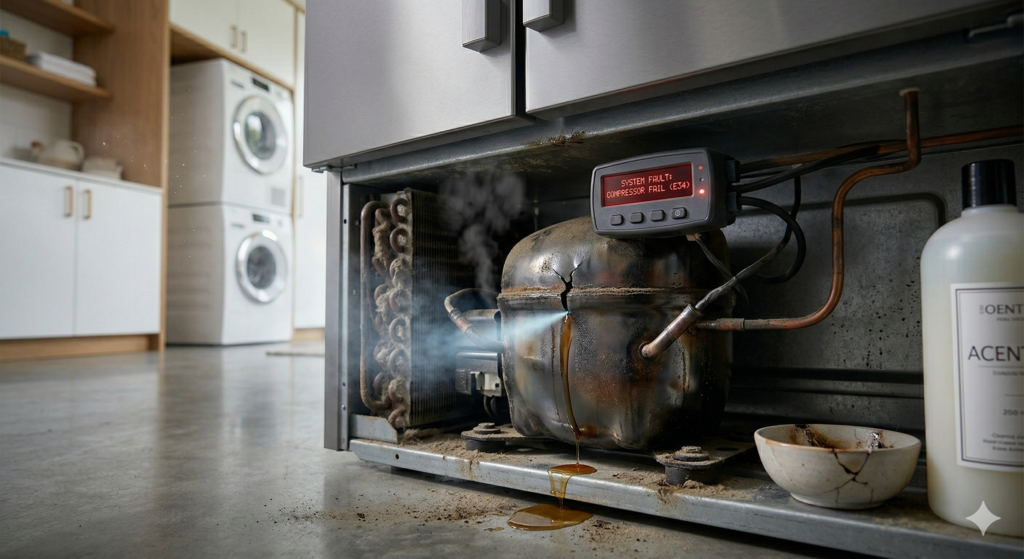
The compressor is the heart of your refrigerator’s cooling system — a small but mighty pump that circulates refrigerant through the coils to remove heat from the interior. When the compressor starts to fail, everything downstream suffers. Food spoils faster, the fridge runs constantly, and electricity bills creep up. Catching compressor problems early can mean the difference between a straightforward repair and a full appliance replacement.
In this guide, we’ll explain exactly what the compressor does, the warning signs that it’s failing, how to distinguish compressor problems from other issues, and what your options are when the diagnosis points to the compressor. If you’re in Coquitlam, Port Coquitlam, or Port Moody, Tricity Repairs can assess your refrigerator quickly.
What Does the Refrigerator Compressor Do?
The compressor is an electrically driven pump that pressurizes the refrigerant gas and circulates it through the sealed cooling system. Here’s the basic cycle: the compressor pressurizes low-pressure refrigerant gas into a high-pressure, high-temperature gas; it flows to the condenser coils (at the back or bottom of the fridge) where it releases heat into the room and condenses into a liquid; the liquid refrigerant then passes through an expansion valve and evaporates inside the evaporator coils inside the fridge, absorbing heat from the interior in the process; the low-pressure gas cycles back to the compressor and the process repeats.
The compressor runs in cycles — turning on when the interior temperature rises above the set point, running until the target temperature is reached, then shutting off. In a healthy refrigerator, it might run 30%–80% of the time depending on ambient temperature, how often the door is opened, and how full the fridge is.
Warning Signs Your Compressor Is Failing
1. Refrigerator Running Constantly Without Cycling Off
A healthy compressor cycles on and off throughout the day. When the compressor is weakening, it struggles to build the pressure needed to properly circulate refrigerant — so it keeps running in a futile attempt to cool the interior. If your fridge seems to never turn off, this is one of the earliest and most consistent signs of compressor trouble.
Note that a constantly running fridge can also be caused by dirty condenser coils, a failing door gasket, or a defrost system problem — so rule those out first before concluding it’s the compressor. For more on this, read our guide: Common Refrigerator Mistakes That Lead to Costly Repairs.
2. Fridge Not Maintaining Temperature (But Still Running)
If the compressor is running but the refrigerator compartment is warmer than it should be — especially if the freezer is also underperforming — the compressor may no longer be building adequate pressure. This can happen as internal compressor components wear down, reducing pumping efficiency without the compressor failing completely.
Use a refrigerator thermometer to check the actual temperature in both the fridge (should be 1–4°C / 34–39°F) and freezer (should be -18°C / 0°F or below). Consistent readings above these ranges, combined with a compressor that’s running, point toward refrigerant or compressor issues.
3. Loud or Unusual Noises from the Compressor
A healthy compressor makes a low, steady hum when running — barely noticeable from across the room. As it ages, several types of abnormal sounds can emerge:
- Clicking or knocking on start-up: The compressor is struggling to start, often due to a failed start relay (a small component that helps kick the compressor into operation). This is actually one of the more affordable repairs — the start relay itself can be replaced without touching the compressor.
- Loud rattling or vibrating: The compressor may be loose on its mounting, or internal components may be wearing out.
- High-pitched squealing or grinding: Indicates significant internal wear — the compressor may be nearing the end of its life.
4. The Compressor Starts Then Immediately Shuts Off
If you hear the compressor click on, run for just a few seconds, then shut off again (and this repeats frequently), this is called “short cycling.” It often indicates the start relay has failed, or that the compressor is overheating due to poor ventilation or internal problems. The thermal overload protector inside the compressor cuts power when it overheats to prevent damage — but if this is happening repeatedly, it’s a signal that something is wrong.
5. Warm Food Despite Correct Settings
If food in your refrigerator has been spoiling faster than it should, or dairy is going off before its use-by date, temperature is likely the issue. A failing compressor may keep the fridge around 7–10°C rather than the safe 1–4°C range — cold enough to feel chilly but too warm to properly preserve food.
6. Compressor Is Hot to the Touch
The compressor (located at the back bottom of the fridge, usually a black dome-shaped component) should feel warm when running — but not burning hot. An extremely hot compressor that’s also running constantly suggests it’s working far harder than it should, either due to restricted airflow, dirty condenser coils, or internal wear.
Always clean condenser coils before drawing conclusions about the compressor — heavily clogged coils force the compressor to work overtime and can cause exactly these symptoms without the compressor itself being the root cause.
Diagnosing the Compressor vs. Other Issues
Many refrigerator symptoms that suggest compressor failure are actually caused by other, more easily repaired components. Before concluding the compressor has failed, a technician will typically check:
- Start relay: A failed start relay prevents the compressor from starting properly. Replacing it (a simple, inexpensive part) sometimes restores full compressor function.
- Condenser coils: Clogged coils are the most common cause of a hard-working, overheating compressor. Clean them and see if symptoms resolve.
- Evaporator fan: If the fan that circulates cold air through the fridge isn’t working, the fridge will warm up even with a healthy compressor.
- Defrost system: Ice buildup on the evaporator coils blocks airflow and mimics compressor failure symptoms.
- Refrigerant level: A slow refrigerant leak reduces cooling capacity without the compressor failing outright. Recharging refrigerant (a job for licensed technicians) may restore performance.
For related refrigerator troubleshooting, see: Refrigerator Running But Not Cooling? Here’s Why.
Can You Test the Compressor Yourself?
There are a few simple checks a homeowner can do. The shake test for the start relay: unplug the fridge, access the compressor at the back bottom, locate the small plug-in component on the side of the compressor (the start relay), remove it, and shake it. If it rattles, the relay has likely failed and should be replaced. New start relays are inexpensive and model-specific — a straightforward repair.
Beyond this, testing the compressor itself requires a multimeter and knowledge of the correct resistance specifications for your model. Most homeowners are better served by having a technician perform this diagnosis.
Repair vs. Replace: The Compressor Dilemma
Compressor replacement is one of the most expensive refrigerator repairs. The compressor itself is costly, and the labour involved — including handling refrigerant, which requires certification — adds to the bill. As a general guideline:
- If the refrigerator is less than 7 years old and otherwise in good condition, compressor repair or replacement may be worthwhile, especially for a high-end model.
- If the refrigerator is 8–12 years old, the repair-vs-replace calculation is more nuanced. A compressor repair may give you another 3–5 years, but other components are also aging.
- If the refrigerator is over 12–15 years old, replacement is usually the more sensible investment.
For a detailed guide to this decision, see: Repair vs. Replace: Appliance Cost Guide.
When to Call Tricity Repairs
If your refrigerator is showing two or more of the warning signs above — constantly running, not maintaining temperature, making unusual noises — it’s time for a professional diagnosis. A technician can test the start relay, check refrigerant pressure, inspect the condenser and evaporator systems, and give you an accurate assessment of the compressor’s condition.
Tricity Repairs serves Coquitlam, Port Coquitlam, and Port Moody with expert refrigerator repair. We service all major brands including Samsung, LG, Whirlpool, Frigidaire, and GE. Call us at (604) 359-5952 for a fast, honest diagnosis.
Summary
A failing refrigerator compressor typically shows up as constant running, poor temperature maintenance, unusual clicking or grinding sounds, or a compressor that starts and immediately shuts off. Many of these symptoms overlap with other, more affordable issues — dirty coils, a failed start relay, or a defrost problem — so accurate diagnosis matters before committing to a repair. Catching compressor problems early, and maintaining your fridge with regular coil cleaning, gives your appliance the best chance of a long, reliable life.