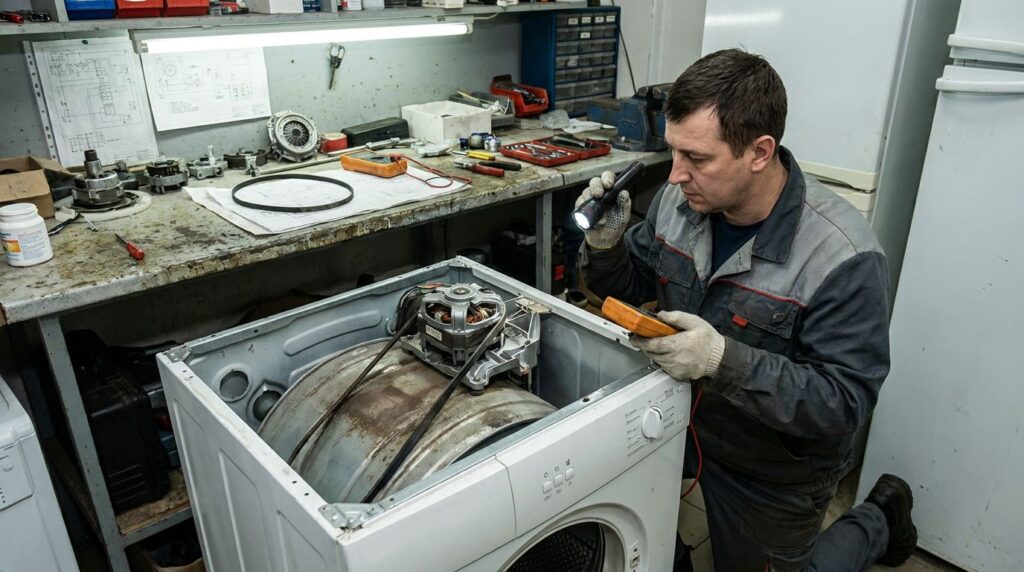
When a dryer drum stops spinning, a broken belt is usually the first suspect — and often rightly so. But if you’ve already checked the belt and it looks fine, or if you’ve replaced it and the drum still won’t turn, there are several other components that could be responsible. Understanding the full picture of what drives the drum rotation helps you diagnose the real culprit and get your dryer working again without guessing.
This guide covers all the reasons a dryer drum might not spin other than a broken belt, how to test each one, and when to call in a professional. Tricity Repairs serves Coquitlam, Port Coquitlam, and Port Moody for all dryer repairs.
Quick Recap: How the Drum Spins
The drive motor turns a pulley, which drives the drum belt, which wraps around the drum and makes it rotate. The idler pulley maintains tension on the belt. Drum glides and a rear bearing support the drum as it turns. If any of these components fail, the drum can stop spinning even if the motor is running and the belt is intact.
Causes of a Dryer Not Spinning (Belt Is Fine)
1. Failed Drive Motor
The drive motor is what powers the entire drum rotation system. If the motor fails, nothing spins — even with a perfect belt and a functioning idler pulley. Motor failure typically presents in one of two ways:
- Motor hums but drum won’t turn: The motor is receiving power but can’t get started. This often means the motor’s start winding has failed, or there’s a mechanical jam preventing rotation.
- Complete silence when the dryer starts: The motor may have failed entirely, with no power reaching it, or the thermal overload protector has tripped and cut power to the motor.
You can test the motor with a multimeter, but motor replacement is a more involved repair that’s best handled professionally. A functioning motor typically costs more than a belt but less than a new dryer in most cases — worth repairing if the machine is otherwise in good shape.
2. Worn or Seized Idler Pulley
The idler pulley is a spring-tensioned wheel that keeps the drive belt taut against the drum and motor pulley. When this pulley seizes (its bearing wears out and it can no longer spin freely), the belt can’t move even if the motor is running. The belt may slip, screech, or snap under the load of a seized pulley.
Test the idler pulley by hand with the dryer unplugged and belt removed: it should spin freely with minimal resistance. Any stiffness, grinding, or wobble means the pulley needs replacement. Idler pulleys are inexpensive and replacement is usually straightforward — many technicians replace the belt and idler pulley together as a matter of course since they wear at similar rates.
3. Worn Drum Support Glides or Rollers
The drum doesn’t float freely — it rests on small plastic glides or rollers at the front of the machine (and sometimes a roller at the rear), which allow it to rotate smoothly. When these glides wear down, the drum can drop slightly and drag against the housing, creating so much friction that the belt can’t turn it effectively. The motor keeps running but the drum barely moves or doesn’t move at all.
Signs of worn glides include a squealing or grinding noise that has been getting progressively louder over recent weeks or months, the drum feeling stiff when you try to spin it by hand, or visible flat spots or grooves worn into the plastic glides when you open the dryer and inspect them.
Replacing drum glides requires disassembling the front panel of the dryer, but the parts are inexpensive and the repair is worthwhile — worn glides also cause excessive belt and motor wear if left unaddressed.
4. Drum Bearing Failure
The rear of the drum is typically supported by a bearing or a shaft that allows it to rotate. When this bearing seizes or wears out, the rear of the drum has no support and drags — making it extremely difficult for the motor to turn. This usually produces a loud grinding or squealing sound that gets worse over time, culminating in the drum completely stopping.
Rear drum bearing replacement is more labour-intensive than glide replacement since it requires fully disassembling the dryer from the rear. On some models, the cost of parts and labour approaches the cost of a replacement machine for older units — making this a clear repair-versus-replace decision point.
5. Thermal Fuse or Door Switch Preventing Motor Start
If the motor seems completely dead — no hum, no movement — the problem may not be the motor at all. Two safety components can cut power to the motor entirely:
- Thermal fuse: A one-time safety device that blows if the dryer overheats. Once blown, it cuts power to the motor (and/or heating element) permanently until replaced. The dryer will appear completely dead or may run but produce no heat or drum rotation. A blown thermal fuse is a common cause of a dryer that simply won’t do anything when started.
- Door switch: The dryer’s safety switch confirms the door is closed before allowing the motor to run. A failed door switch prevents the motor from receiving power. Test by pressing the door switch manually while starting the dryer — if the drum starts to rotate, the switch needs replacement.
For more on dryer component diagnosis, see: Dryer Not Heating: Parts to Check.
6. Overloaded Drum
An extremely overloaded drum creates so much weight and friction against the drum glides that even a healthy motor and belt struggle to turn it. This is temporary — remove some items and try again. But if this happens regularly, it’s accelerating wear on your belt, idler pulley, and drum glides significantly.
How to Diagnose Without Opening the Dryer
Before disassembling anything, a few quick checks can narrow down the cause:
- Open the door and spin the drum by hand. Does it spin freely? Light resistance is normal; a drum that barely moves by hand points to glide, bearing, or obstruction issues.
- Start the dryer and listen. Motor humming but drum not moving = belt, idler pulley, or mechanical jam. Complete silence = thermal fuse, door switch, or total motor failure.
- Check for error codes on the display if your model has one.
- Inspect for obstructions — sometimes a small item (a sock, a coin) jams between the drum and the housing, preventing rotation.
For related dryer issues, see: How to Maintain Your Dryer and Prevent Fire Hazards.
When to Repair vs. Replace
A thermal fuse, door switch, idler pulley, or drum glides are all low-cost repairs well worth doing on a dryer of any age. A drive motor or rear bearing on an older machine (10+ years) is where the calculation becomes more nuanced. If the dryer is otherwise in good shape, motor replacement can extend its life by many years; on a machine already showing other signs of age, the total cost of multiple repairs may push the decision toward replacement. See: Repair vs. Replace: Appliance Cost Guide.
Professional Dryer Repair in the Tri-Cities
If your dryer drum isn’t spinning and the basic checks haven’t resolved it, Tricity Repairs can diagnose and fix the problem efficiently. We service Coquitlam, Port Coquitlam, and Port Moody and carry parts for all major brands including Samsung, LG, Whirlpool, Maytag, and GE. Call us at (604) 359-5952 to book a same-week appointment.
Summary
A dryer drum that won’t spin despite an intact belt is usually caused by a failed idler pulley, worn drum glides, a seized rear bearing, a blown thermal fuse, or a failed drive motor. Work through the quick hand-spin and listening tests first, then inspect components in order from least to most expensive to replace. Catching idler pulley and glide wear early prevents more costly motor and bearing damage down the line.