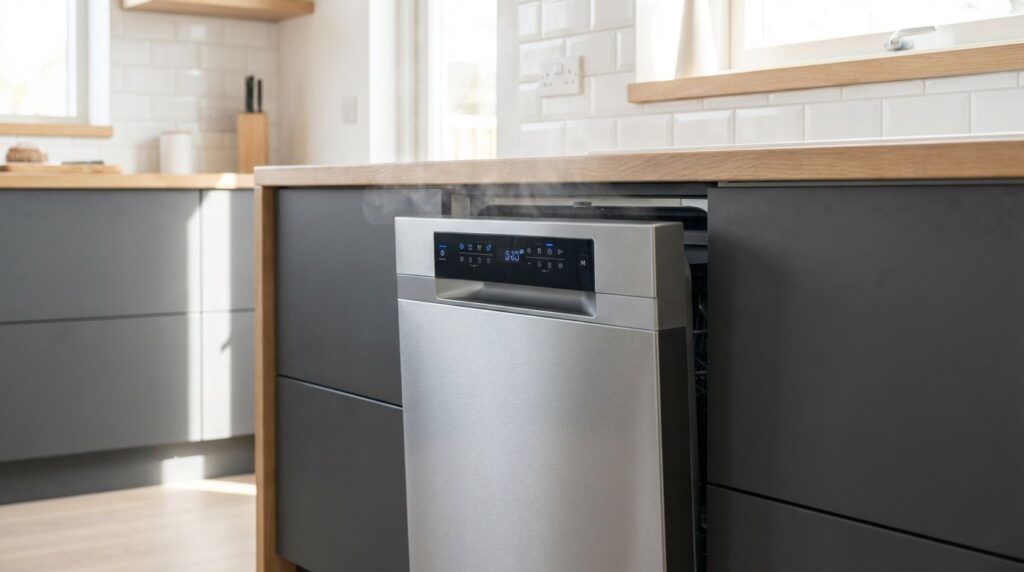
A standard dishwasher cycle used to take about 60–90 minutes. If your dishwasher is now running for two, three, or even four hours on what should be a normal cycle, something isn’t working as it should. A dishwasher that takes too long is not just inconvenient — it uses significantly more water and electricity than necessary, and it usually signals an underlying problem that will get worse if ignored.
At Tri-City Repairs, we help homeowners across Coquitlam, Port Coquitlam, and Port Moody get to the bottom of dishwasher issues like this. Here’s a breakdown of why dishwasher cycles stretch well beyond their normal length — and what you can do about it.
First: Are Long Cycles Normal for Your Model?
Before troubleshooting, it’s worth noting that modern dishwashers — particularly Energy Star-certified models — are designed to use less water and energy by running longer at lower temperatures. A cycle that runs 90–120 minutes on an eco setting is entirely normal for a newer machine. Check your owner’s manual for the expected cycle times for each setting on your model.
If your cycle has recently gotten much longer than it used to be — or if it’s exceeding 2.5 hours on a normal cycle — that’s the problem we’re addressing here.
Common Reasons a Dishwasher Cycle Takes Too Long
1. Water Not Reaching the Right Temperature
This is the most frequent cause of extended cycle times. Modern dishwashers use a temperature sensor (thermistor) to monitor water temperature throughout the cycle. If the water doesn’t reach the target temperature — typically around 120–140°F (49–60°C) — the dishwasher simply waits, extending the cycle until the target is met. If the water never gets there, the cycle can run indefinitely.
Several things can cause this:
- Your home’s water heater is set too low. The water supply entering the dishwasher should be at least 120°F. Check your water heater’s thermostat setting.
- The dishwasher’s internal heating element has failed. The heating element both heats water during the wash and dries dishes during the drying cycle. If it’s failed, the machine will struggle to reach temperature and cycle times will balloon.
- A faulty thermistor (temperature sensor). If the sensor is reading temperatures incorrectly — telling the control board the water is cooler than it actually is — the machine will keep heating trying to reach a target it believes hasn’t been reached.
Our post on 5 Reasons Your Dishwasher’s Water Isn’t Heating Up goes into detail on each of these causes and how to diagnose them.
2. Low Water Pressure or Slow Fill
Dishwashers need adequate water pressure to fill efficiently at the start of each cycle. If your home has low water pressure, or if the water inlet valve on the dishwasher is partially blocked by mineral deposits, the machine fills more slowly than designed — and it waits for the tub to reach the correct water level before proceeding. This adds minutes at the start of each fill, which compounds over multiple cycles.
Signs of a filling issue: You can hear the dishwasher running but the cycle seems to stall or pause repeatedly, particularly at the beginning. Inside the tub, the water level may be noticeably lower than usual.
Try running the kitchen tap to check your home’s hot water pressure. If pressure seems weak throughout the house, that’s a plumbing issue. If it’s isolated to the dishwasher, a blocked inlet screen or failing inlet valve is the more likely cause.
3. Drainage Problems Causing Cycle Delays
At several points in a dishwasher cycle, the machine pauses to drain before moving to the next phase. If the drain is partially clogged — due to a dirty filter, a blocked hose, or a failing drain pump — the machine either drains slowly (causing the cycle to wait) or triggers a fault detection that pauses the cycle while the control board attempts to resolve the problem.
A dirty filter is the most common and easiest-to-fix culprit. Pull out the bottom rack, remove the filter from the tub floor, and clean it thoroughly under running water. You’d be surprised how much a clogged filter alone can slow down a cycle.
For a complete guide on drain issues, see Dishwasher Leaves a Film on Glasses — residue buildup and drainage problems are closely linked.
4. Faulty Door Latch or Door Switch
Your dishwasher has a door latch and a door switch that confirm the door is properly closed before the cycle proceeds. If the latch is misaligned or the switch is intermittently failing, the machine may pause mid-cycle as it briefly detects an “open door” condition, then restart the phase. This can add significant time to a cycle without producing any error messages — the machine just keeps running.
Signs of this problem: The cycle seems to restart phases rather than progressing linearly. You may notice the pump or spray arms going through the same motions multiple times.
5. Control Board Malfunction
The electronic control board manages the sequencing and timing of every phase of the dishwasher cycle. A failing control board may not advance through cycle phases at the correct time, causing phases to run longer than they should or cycle steps to repeat. This is one of the harder-to-diagnose issues because the symptoms can mimic several other problems.
Control board failures are usually accompanied by other symptoms — error codes, random pausing, cycles that don’t complete at all, or inconsistent behaviour from cycle to cycle. If the machine’s behaviour seems truly unpredictable rather than consistently slow, the control board is worth investigating.
6. Mineral Buildup on Internal Components
Hard water deposits accumulate on the spray arms, the heating element, and the internal water distribution channels over time. When the spray arm holes become partially blocked with mineral scale, water pressure and coverage drop — and the dishwasher compensates by running longer to achieve the same wash result.
Descaling your dishwasher with citric acid or white vinegar monthly can help manage this buildup. Place a dishwasher-safe cup of white vinegar upright on the top rack and run a hot cycle with no detergent and no dishes once a month. This dissolves mineral deposits from internal components effectively.
How to Diagnose the Problem Yourself
Here’s a practical diagnostic approach:
- Check your water heater temperature — set to at least 120°F/49°C.
- Run hot water at the kitchen sink before starting the dishwasher — this ensures the initial fill uses already-hot water rather than waiting for hot water to travel from the heater.
- Clean the filter — if it hasn’t been cleaned recently, do it now.
- Run a cycle while monitoring — listen and note at which phase the cycle seems to stall or slow. Does it stall during fill? During wash? During drain? This narrows the culprit.
- Check for error codes — consult your manual if the display shows any fault codes.
Not sure whether the cost of a repair is worth it on your current dishwasher? DIY vs Professional Appliance Repair: When to Call the Experts gives you a practical framework for making that call.
Preventing Long Cycles: Maintenance Tips
- Run hot water at the sink before starting the dishwasher — pre-warms the supply line.
- Clean the filter monthly — the single most effective maintenance habit.
- Descale monthly with vinegar or citric acid — keeps spray arms and the heating element clear.
- Check the door gasket — a worn seal lets heat escape, making the heating element work harder and longer.
- Don’t use the heated dry setting if you don’t need it — air dry saves energy and reduces heating element wear.
When to Call Tri-City Repairs
If you’ve cleaned the filter, confirmed hot water supply, and the cycle is still running far longer than expected — or if the dishwasher is showing error codes, failing to drain, or not heating the water — it’s time for a professional diagnosis. Our technicians can test the heating element, thermistor, inlet valve, and control board quickly and accurately.
We serve dishwasher repairs throughout Coquitlam, Port Coquitlam, and Port Moody. Call Tri-City Repairs at (604) 359-5952 or book your appointment at tricityrepairs.ca.