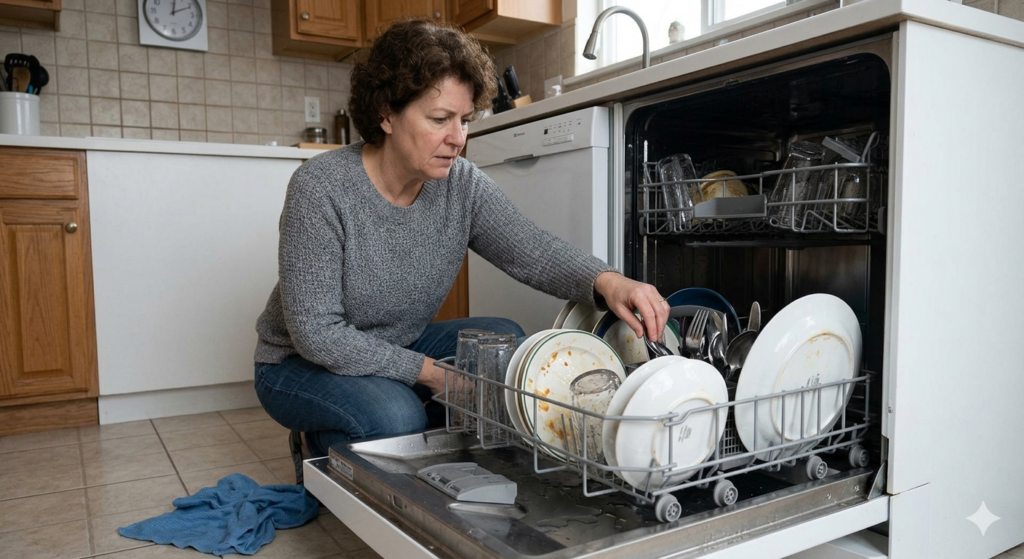
A dishwasher that isn’t heating its water is one of those problems that’s easy to miss at first — the machine still runs, dishes still get wet, and everything looks normal. But if you’re pulling out dishes that are still greasy, glasses with film, or cutlery that feels less than clean, water temperature is likely the culprit. Dishwashers need hot water (typically 49°C to 60°C / 120°F to 140°F) to properly dissolve detergent, cut through grease, and sanitize surfaces.
In this guide, we’ll cover the five most common reasons your dishwasher’s water isn’t heating up, how to identify which one you’re dealing with, and what you can do about it. If you’re in Coquitlam, Port Coquitlam, or Port Moody, Tricity Repairs is here to help.
Why Hot Water Matters in a Dishwasher
Before diving into causes, it’s worth understanding why the heating element and water temperature are so critical. Modern dishwasher detergents — especially pods and powder — are formulated to activate and dissolve at higher temperatures. Cold or lukewarm water leaves detergent partially undissolved, which means residue on dishes rather than clean surfaces.
Hot water also softens grease and food particles that cooler water simply pushes around. And the drying phase on most dishwashers relies on the residual heat of hot water to evaporate moisture from dishes — which is why a cold wash cycle often results in wet dishes at the end, even with rinse aid.
5 Reasons Your Dishwasher Water Isn’t Heating Up
1. Faulty Heating Element
This is the most common cause. The heating element is a coiled metal rod (usually visible at the bottom of the dishwasher tub) that heats the water during the wash cycle and helps dry dishes afterward. Over time, heating elements can burn out, crack, or develop breaks in the coil that prevent them from conducting electricity properly.
Signs of a failed heating element include dishes that are cold and wet at the end of a cycle, detergent pods that are partially dissolved or sitting intact in the bottom of the tub, and a dishwasher that completes the cycle but takes longer than usual.
Testing a heating element requires a multimeter — set to continuity or resistance (ohms). Disconnect power to the dishwasher, access the element terminals under the tub, and test across them. A functioning element will show resistance (typically 15–30 ohms for most brands). No continuity means the element has failed and needs replacement.
2. Failed Thermostat or High-Limit Thermostat
Dishwashers use one or more thermostats to regulate water temperature. The operating thermostat tells the heating element when to turn on and off during the cycle. The high-limit thermostat is a safety device that cuts power to the element if water gets dangerously hot, preventing damage to the machine and dishes.
If the operating thermostat fails in the open position, the heating element never receives the signal to activate — so water stays at whatever temperature it entered the machine (usually around 40°C from your hot water line). If the high-limit thermostat has tripped or failed, it may permanently cut power to the element even at normal temperatures.
Both thermostats can be tested with a multimeter for continuity. A tripped high-limit thermostat can sometimes be reset manually, but a failed one needs replacement.
3. Control Board or Wash Cycle Settings Issue
Modern dishwashers have electronic control boards that manage all cycle functions, including when and how long the heating element runs. A failing control board can send incorrect signals — or no signal at all — to the heating element, even if the element itself is perfectly functional.
Control board issues are often accompanied by other symptoms: error codes on the display, cycles that behave erratically, or functions that stop working intermittently. Before assuming a control board failure, check whether you’ve accidentally selected an eco or cold-wash cycle that intentionally reduces water heating. Some “quick” or “light” cycles use less heat by design.
4. Incoming Water Temperature Is Too Low
This one surprises many homeowners: if your home’s hot water heater is set below 49°C (120°F), or if the dishwasher is far from the water heater and the hot water line runs cold before each cycle, the water entering your dishwasher may simply be too cool to begin with — putting all the burden on the internal heating element.
A simple test: run your kitchen sink hot tap for 30–60 seconds before starting the dishwasher. This purges the cold water sitting in the supply line and ensures the machine fills with actually-hot water from the start. If cleaning performance improves noticeably, your water supply temperature is part of the problem. Check your water heater’s thermostat setting — most manufacturers recommend 49°C (120°F) as the minimum for dishwasher performance.
5. Defective Wash Pump or Circulation Pump
Some dishwasher models heat water via the heating element only when the pump is circulating — the element is submerged and in contact with moving water. If the circulation pump is failing and water isn’t moving properly through the system, the element may not heat effectively, or the temperature sensor may not register the correct temperature and cut the heating cycle short.
Signs of a pump issue include poor spray pressure during the cycle (dishes on the top rack not getting cleaned), unusual noise during washing, or the dishwasher stopping partway through a cycle. This is typically confirmed by a technician.
Quick Checks Before Calling a Technician
- Check your cycle selection — make sure you’re not running an eco, rinse-only, or light cycle that intentionally uses less heat.
- Run hot water at the sink first — purge the cold water from the supply line before starting the dishwasher.
- Inspect the heating element visually — open the dishwasher and look at the coil at the bottom. Visible cracks, burn marks, or breaks in the coil indicate failure.
- Check detergent dissolving — if pods or powder aren’t dissolving fully, temperature is likely the issue.
- Feel the dishwasher door mid-cycle — on most machines, the door should feel noticeably warm to the touch during the main wash phase.
For related dishwasher troubleshooting, see: Dishwasher Not Draining: Troubleshooting Guide.
What Happens If You Keep Running It with Cold Water?
Running your dishwasher without adequate water heating isn’t just an inefficiency — it has real consequences. Grease and food residue build up in the spray arms, filter, and interior walls faster than in a properly heated machine. Detergent residue accumulates and can eventually clog spray arm nozzles. And over time, the combination of food residue and detergent film creates that familiar unpleasant dishwasher smell.
If you’ve noticed a persistent odour from your dishwasher, heating problems may be a contributing factor. For more, see: Dishwasher Drying Tricks That Actually Work.
How Much Does It Cost to Fix?
The heating element is the most commonly replaced part for this issue, and it’s usually one of the more affordable dishwasher repairs. The element itself is inexpensive for most brands, and replacement is manageable for a technician. Thermostat replacement is similarly affordable. Control board replacement can be more significant depending on the model — which is why accurate diagnosis first matters so much.
For help deciding whether repair or replacement makes more sense for your dishwasher, see: Repair vs. Replace: Appliance Cost Guide.
Professional Dishwasher Repair in the Tri-Cities
If you’ve confirmed that your dishwasher isn’t heating properly and the basic checks haven’t identified an obvious fix, it’s time for a professional diagnosis. A technician can test the heating element, thermostats, and control board systematically to identify the exact faulty component — saving you from guessing and purchasing the wrong part.
Tricity Repairs serves Coquitlam, Port Coquitlam, and Port Moody with expert dishwasher repair. We carry parts for all major brands including Bosch, Samsung, LG, Whirlpool, and Frigidaire. Call us at (604) 359-5952 to book a same-week service appointment.
Summary
A dishwasher that isn’t heating water is most commonly caused by a failed heating element, a malfunctioning thermostat, or incoming water that’s too cold. Start with the simple checks — cycle settings, supply temperature, and visual element inspection — before moving to component testing. Addressing the problem promptly protects your dishwasher’s long-term health and ensures your dishes are actually clean, not just wet.