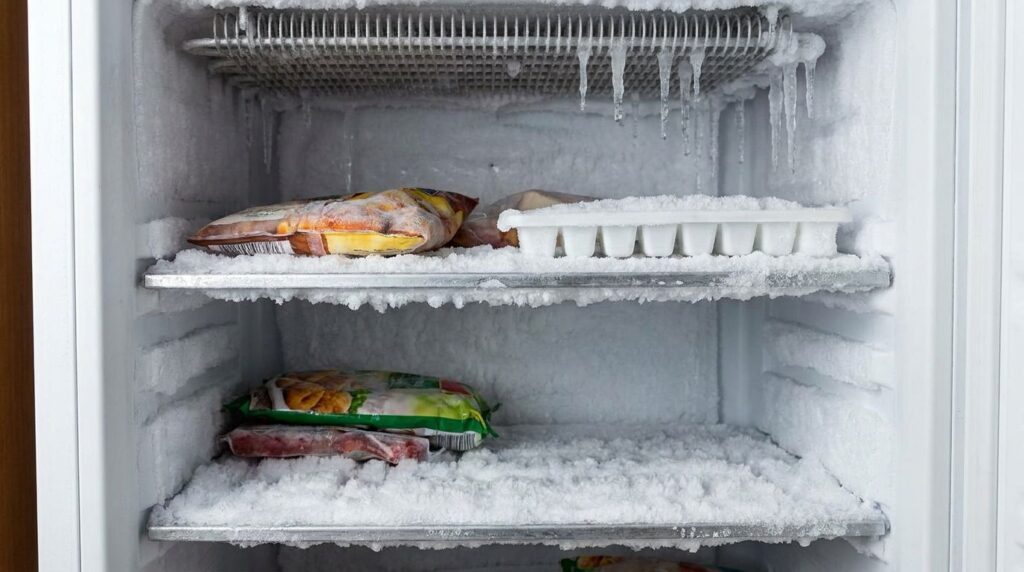
Your refrigerator is designed to frost up slightly on its evaporator coils as they absorb heat from the interior — and then automatically defrost that frost several times per day using a built-in defrost system. When this automatic defrost system fails, ice builds up on the evaporator coils progressively until they’re completely encased in a solid block of ice. At that point, the refrigerator loses its ability to cool properly, the fridge section warms up while the freezer may still seem cold, and food starts to spoil.
This guide covers the signs that your refrigerator’s defrost system has failed, what causes it, and what your repair options are. Tricity Repairs serves Coquitlam, Port Coquitlam, and Port Moody for all refrigerator repairs.
How the Automatic Defrost System Works
The defrost system has three main components working together: a defrost timer or control board that initiates the defrost cycle (typically several times per day for 20–30 minutes each), a defrost heater that melts frost off the evaporator coils, and a defrost thermostat (or thermal limiter) that monitors temperature and cuts power to the heater once defrost is complete to prevent overheating. Meltwater drains through a drain tube to a pan beneath the fridge where it evaporates.
A failure in any of these components breaks the cycle — frost accumulates unchecked.
Signs Your Refrigerator’s Defrost System Has Failed
- Heavy frost or a solid block of ice visible at the back of the freezer compartment (behind the freezer back panel)
- The refrigerator section is warmer than normal while the freezer still seems cold
- A clicking or rattling sound coming from the freezer (the evaporator fan hitting ice buildup)
- Food in the freezer near the back wall has visible frost or freezer burn
- Reduced airflow from the refrigerator vents — cold air feels weaker than normal
- Water pooling at the bottom of the refrigerator or beneath the fridge (from melted ice draining incorrectly)
The Test: Manual Defrost
Before replacing any components, you can confirm a defrost failure and temporarily restore cooling by manually defrosting: unplug the refrigerator, remove all food to a cooler, and leave both doors open for 24–48 hours until all ice has melted. Place towels to absorb meltwater. If the refrigerator cools normally after this manual defrost but then fails again within a few weeks, the defrost system has definitely failed.
Common Causes of Defrost System Failure
1. Failed Defrost Heater
The defrost heater is a coiled glass or metal heating element that runs along or around the evaporator coils. When it fails — either burning out completely or developing a break — frost builds up without any melting. Testing requires a multimeter: the heater should show continuity and resistance within the manufacturer’s specified range. No continuity = failed heater, which needs replacement.
This is one of the more common refrigerator repairs and is manageable for experienced DIYers, though it requires removing the freezer back panel and working around the evaporator assembly.
2. Failed Defrost Thermostat
The defrost thermostat (also called a thermal limiter or defrost cutout) monitors the temperature of the evaporator coils and cuts power to the heater once defrost is complete. If it fails in the open position, it permanently cuts power to the heater — so defrost never occurs. If it fails in the closed position, the heater may run too long (causing the evaporator area to overheat), though this is less common.
Testing: the thermostat should show continuity when it’s cold (below its rated temperature) and open circuit when warm. If it shows no continuity even when cold, it has failed. For more on refrigerator component issues, see: Signs Your Refrigerator Compressor Is Failing.
3. Failed Defrost Timer (Older Models)
Older refrigerators use a mechanical defrost timer — a small motor-driven cam that advances through a cycle and triggers defrost at set intervals. When this timer motor fails, the defrost cycle stops initiating. You can test a mechanical timer by manually advancing it (usually by turning a notch on the timer body with a screwdriver) — if the defrost heater comes on when you advance the timer, the timer itself is the faulty component.
4. Control Board Defrost Failure (Modern Models)
Modern refrigerators replace the mechanical timer with an adaptive defrost control board that adjusts defrost frequency based on door opening patterns and compressor run time. When this board fails to initiate defrost cycles, ice builds up exactly as with a failed timer. Control board diagnosis typically involves confirming the heater and thermostat are functional first — if they test fine but defrost isn’t occurring, the board is the likely cause.
5. Clogged Defrost Drain
The drain tube that carries meltwater from the evaporator area to the drip pan can become clogged with ice, food debris, or mould. When blocked, meltwater during defrost has nowhere to go and refreezes — eventually building up a pool of ice at the bottom of the freezer and potentially overflowing into the refrigerator compartment. This presents differently from a complete defrost failure — the heater is working, but drainage isn’t. For related issues, see: Why Is My Refrigerator Leaking Water on the Floor?.
How to Access the Evaporator Coils
To inspect the evaporator coils, you typically need to remove the back panel inside the freezer compartment — usually held by several screws. Behind this panel you’ll find the evaporator coils and the defrost heater. If the coils are encased in ice (rather than showing just a light frost coating), the defrost system has failed. The defrost heater and thermostat are accessible from this point.
Repair Cost vs. Appliance Age
Defrost heater and thermostat replacement are generally affordable repairs. A mechanical timer is also inexpensive. Control board replacement is more significant. On a refrigerator that’s otherwise in good condition, any of these repairs is worth doing. On a machine that’s 12–15+ years old with other issues, factor the total repair cost against the remaining useful life.
Professional Repair in the Tri-Cities
Tricity Repairs serves Coquitlam, Port Coquitlam, and Port Moody with refrigerator defrost system repair. We diagnose the specific failed component accurately and carry parts for all major brands. Call us at (604) 359-5952 for a same-week appointment. For related maintenance, see: How to Clean Your Refrigerator Condenser Coils.
Summary
A refrigerator that won’t defrost is almost always caused by a failed defrost heater, thermostat, timer, or control board. The clearest symptom is heavy ice buildup on the evaporator coils behind the freezer panel, combined with a refrigerator section that’s too warm. Manual defrosting temporarily restores cooling and confirms the diagnosis. Component replacement — particularly heater and thermostat — is affordable and immediately resolves the problem.