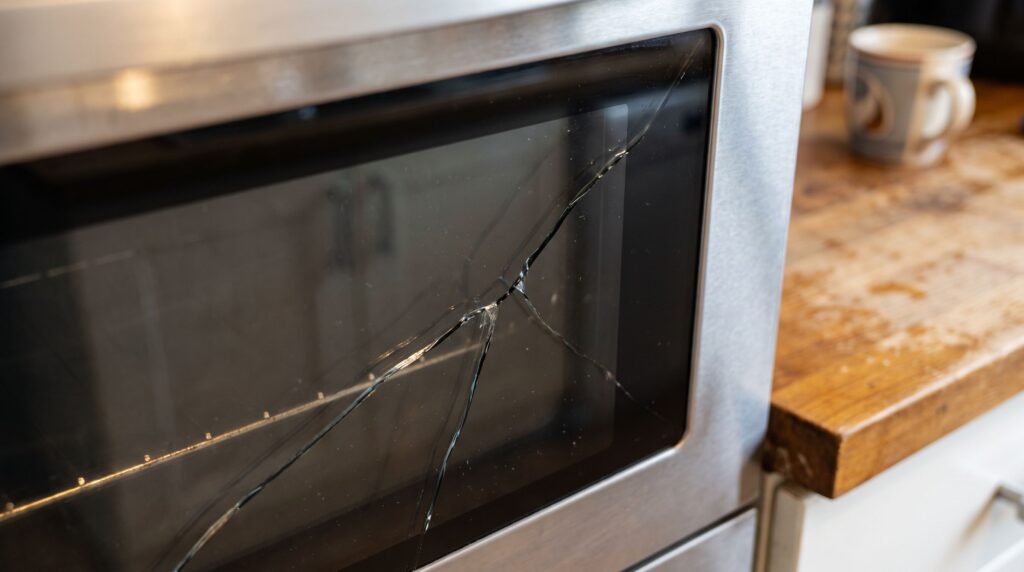
Finding your oven door glass cracked — or worse, shattered across the kitchen floor — is startling and can feel dangerous. Oven glass failures do happen, and while the cause isn’t always obvious, the next steps are: stop using the oven, understand what caused it, and arrange repair before the next use. This guide explains why oven glass breaks, whether it’s safe to use the oven afterward, and what’s involved in getting it fixed.
Tricity Repairs serves Coquitlam, Port Coquitlam, and Port Moody for oven repairs.
Is Oven Door Glass Dangerous When It Breaks?
Oven doors use tempered safety glass, which is designed to shatter into small, rounded fragments rather than sharp shards — the same type used in car side windows. While still unpleasant to clean up, tempered glass is far safer than standard glass when it breaks. However, you should not attempt to use the oven with cracked or missing door glass — heat will escape from the oven cavity, the door seals will be compromised, and remaining glass fragments can fall further.
Why Oven Door Glass Breaks
Thermal Shock
The most common cause is thermal shock — a sudden and extreme temperature change. Cold water splashing onto hot glass (from a pot boiling over, cleaning a hot oven, or a wet oven mitt placed on the door) causes rapid, uneven expansion and contraction that tempered glass can’t accommodate. The glass can crack or explode with a loud bang that’s surprising even if no one is near the oven.
This is why oven cleaning instructions almost always specify that the oven must be completely cool before applying water or cleaning solutions. The self-clean cycle generates temperatures above 500°C (930°F) — even 30 minutes after the cycle ends, the glass is still hot enough to crack from cold contact.
Physical Impact
A hard knock — a heavy pot, a baking sheet edge, or a cabinet door hitting the glass — can crack or shatter the inner or outer glass panel. Sometimes a small chip or nick from an earlier impact weakens the glass structurally, and it fails days or weeks later when heat stress accumulates.
Manufacturing Defect or Stress Fractures
Less commonly, tempered glass can have microscopic inclusions (often nickel sulfide particles introduced during manufacturing) that slowly expand under repeated heat cycling. This can cause spontaneous shattering — the glass breaks without any obvious external cause. This is a known phenomenon with tempered glass and is why some manufacturers have issued recalls for specific oven models.
Hinge or Frame Misalignment
If the oven door hinges are worn or misaligned, the door may not sit square in its frame. This creates uneven mechanical stress on the glass panel during normal use — especially when the door is opened or closed. Over time, this stress causes cracking along the edges of the glass.
Inner vs. Outer Glass Panel
Most oven doors contain two or more glass panels — an outer panel (the one you see when looking at the closed door) and an inner panel (inside the oven cavity). Both can crack independently. Outer glass cracks are usually caused by physical impact. Inner glass cracks are more often the result of thermal shock from food spills, cleaning, or the self-clean cycle. The repair cost and process differ: the outer panel is often accessible without full door disassembly, while the inner panel typically requires removing the door and separating the frame. For more on oven care, see: How to Deep Clean Your Oven Without Chemicals.
Can You Use the Oven With Cracked Glass?
No. Even a hairline crack in the inner panel allows heat to enter the door cavity and reach the outer surface, creating a burn risk. A crack in the outer panel compromises the structural integrity of the door. Cracked oven glass always needs to be replaced before the oven is used again.
What the Repair Involves
Oven door glass replacement requires sourcing the correct replacement panel for your specific oven model and disassembling the door to access it. Most oven doors are held together by screws concealed behind the handle and inner liner — once disassembled, the glass panel slides out and the replacement slides in. It’s a job that requires model-specific glass and some patience with disassembly, but it’s a well-defined repair that restores the oven fully. Tricity Repairs serves Coquitlam, Port Coquitlam, and Port Moody — call us at (604) 359-5952. See also: Repair vs. Replace: Appliance Cost Guide.
How to Prevent Oven Glass from Breaking
- Always let the oven cool completely before wiping the door glass with any liquid.
- Never place wet items on a hot oven door.
- Avoid banging baking sheets or heavy cookware against the door.
- Inspect door hinges annually and replace worn hinges promptly.
- After the self-clean cycle, allow at least 2 hours before any contact with water.
Summary
Oven door glass breaks due to thermal shock (most commonly), physical impact, manufacturing defects, or hinge misalignment. Stop using the oven as soon as you notice cracking — continued use risks further glass failure and heat leakage. Replacement involves disassembling the door and installing the correct panel for your model, which is a standard appliance repair.