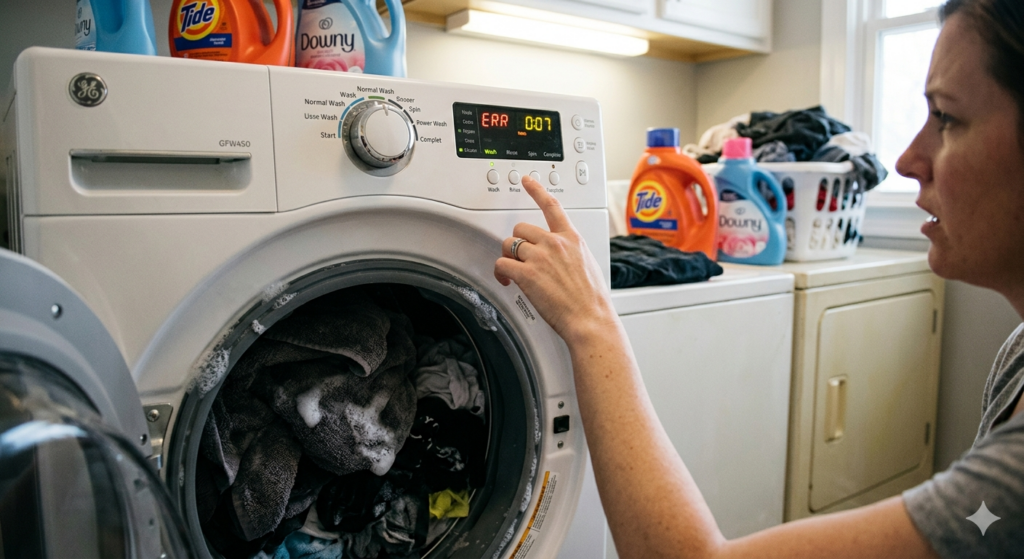
You’ve loaded your laundry, added detergent, and started the wash — but something’s off. The machine seems to skip straight from the wash to the spin without actually rinsing your clothes. Or maybe it just stops mid-cycle altogether. A washing machine that skips the rinse cycle is more than just a nuisance: clothes left with soap residue can irritate skin, fade fabric faster, and develop that musty “not quite clean” smell even straight out of the machine.
The good news is this is a diagnosable problem with a manageable set of causes. In this guide, we’ll walk you through every likely reason your washer is skipping the rinse cycle, how to test for each one, and what to do about it. If you’re in Coquitlam, Port Coquitlam, or Port Moody, Tricity Repairs can help you get to the bottom of it fast.
How the Rinse Cycle Works
Before troubleshooting, it helps to understand what’s supposed to happen. After the wash cycle, your washing machine drains the soapy water, then refills with clean water to rinse out detergent residue from your clothing. Depending on the model and setting, there may be one or two rinse cycles, each followed by a spin to extract water. The machine then drains again before the final spin.
For all of this to happen correctly, several systems need to work together: the water inlet valve (to let in fresh water), the water level sensor or pressure switch (to know when the drum is full), the timer or control board (to advance through cycle stages), and the drain pump (to empty the tub between cycles).
A failure in any of these can cause the rinse to be skipped, abbreviated, or repeated incorrectly.
Common Causes of a Washer Skipping the Rinse Cycle
1. Faulty Lid Switch or Door Latch (Top-Loaders and Front-Loaders)
On top-load washers, the lid switch is a safety mechanism that prevents the drum from spinning with the lid open. But it also plays a role in cycle progression — the machine needs to confirm the lid is closed before advancing from wash to rinse. If the lid switch is worn or broken, the machine may stall at the end of the wash cycle and never advance to the rinse.
On front-loaders, a faulty door latch can send the same kind of incorrect signal to the control board. You might notice the machine pausing mid-cycle, flashing a door error code, or simply stopping and draining without rinsing.
Test the lid switch by pressing it manually with the machine running (top-loaders) — you should hear a click and feel resistance. A switch that feels loose, doesn’t click, or has visible damage is a strong candidate for replacement.
2. Clogged or Faulty Water Inlet Valve
The water inlet valve controls the flow of hot and cold water into the drum. If it’s clogged with mineral deposits or has a failed solenoid, it may not open properly during the rinse fill — meaning the machine tries to fill, detects no water coming in, and skips ahead or times out.
Signs of an inlet valve problem include the rinse cycle being very short or producing little water, a humming sound during fill that produces nothing, or the machine progressing to spin almost immediately after the wash cycle ends.
The inlet screens (small mesh filters where the hoses connect to the valve) are often the culprit and are easy to clean — unscrew the hoses, pull out the screens, and rinse them under water. If the screens are clear but the valve still underperforms, the solenoid coils may need testing with a multimeter.
3. Faulty Water Level Sensor (Pressure Switch)
The pressure switch monitors how much water is in the drum. It works by sensing air pressure in a small tube connected to the bottom of the tub — as water rises, pressure increases, and the switch tells the control board the tub is full. If this switch is malfunctioning, it may incorrectly signal “tub full” when no water has entered, causing the machine to skip the fill portion of the rinse and move on to spin.
A faulty pressure switch can also cause the opposite: the machine overfills during wash or rinse. The switch itself is usually inexpensive; the small air hose connecting it can also crack or clog, causing the same symptoms.
4. Clogged Drain Pump or Filter
If the washer can’t drain properly at the end of the wash cycle, it may get stuck trying to drain — and some machines will skip the rinse entirely if the drain cycle exceeds a set time limit. A partially blocked pump or filter causes slow draining that can trick the machine’s logic into skipping ahead.
Front-loaders typically have an accessible filter at the bottom front of the machine. Check it for coins, lint, small clothing items, or debris. Top-loaders may have a lint filter inside the drum or near the agitator. Clean these regularly — once a month is a good habit.
For more on drainage issues, see our guide: Why Your Washing Machine Won’t Spin: 6 Common Causes and Quick Fixes.
5. Overloading the Machine
A drum stuffed past capacity doesn’t just clean poorly — it can also interrupt cycle progression. An overloaded washer may become unbalanced during the wash, triggering automatic rebalancing attempts that eat up the cycle time. Some machines will abort the rinse and spin to protect the motor from an imbalanced load.
As a general rule, the drum should be no more than three-quarters full for optimal performance. Heavy items like jeans, towels, and blankets should be washed in small loads, never combined into one giant load.
6. Timer or Control Board Malfunction
On older mechanical washers, a timer controls cycle progression by physically advancing through stages. A worn or damaged timer can skip stages, including the rinse, if its contacts become corroded or the motor driving it begins to fail. You may notice the machine jumping ahead in the cycle unexpectedly or getting stuck on one stage for an unusually long time.
On modern electronic washers, the main control board serves the same function. A failing control board can send incorrect signals that cause cycle stages to be skipped or repeated. Control board issues are typically diagnosed after ruling out all other components.
7. Software Glitch (Electronic Models)
Electronic washers can occasionally experience software glitches that disrupt normal cycle progression — especially after a power outage or voltage fluctuation. Before assuming a mechanical failure, try a full reset: unplug the machine, wait 60 seconds, then plug it back in and start a new cycle. This clears temporary faults in many cases. For more on resetting appliances, see: How to Reset Any Appliance.
Diagnosing the Problem: Step by Step
- Reset the machine first — unplug for 60 seconds and try again.
- Run a small test load — try a quick cycle with just a few light items to confirm the issue repeats.
- Watch the cycle closely — does the machine drain after the wash? Does water enter for the rinse? Does the drum fill to a normal level?
- Check the lid switch or door latch — press, listen, and feel for proper engagement.
- Inspect inlet screens — remove hoses and check the screens for mineral buildup.
- Check the drain filter — especially on front-loaders; clean if clogged.
- Avoid overloading — if the problem only happens with large loads, balance is the issue.
Are Clothes Coming Out Soapy?
If your clothes smell of detergent or feel slightly slippery after washing, the rinse is either being skipped or is insufficient. This can also happen if you’re using too much detergent — especially with high-efficiency (HE) machines, which require HE-rated low-suds detergent in smaller quantities. Excess suds can confuse the pressure switch into thinking the drum is full of water when it’s full of foam.
Try running the affected clothes through an extra rinse cycle manually, and switch to the correct amount of HE detergent if applicable.
For tips on keeping your washer in top shape, see: How to Maintain Your Washing Machine.
When to Call a Professional
If the lid switch, inlet screens, and drain filter all look fine and the machine still skips the rinse, you’re likely dealing with a failed pressure switch, control board, or timer — components that benefit from professional diagnosis and replacement.
Tricity Repairs serves Coquitlam, Port Coquitlam, and Port Moody with expert washing machine repair. We diagnose accurately before recommending repairs, and carry parts for all major brands including Samsung, LG, Whirlpool, Maytag, and GE. Call us at (604) 359-5952 and we’ll get your washer completing full cycles again.
Summary
A washing machine that skips the rinse cycle most commonly points to a faulty lid switch, clogged inlet screens, a malfunctioning water level sensor, or a blocked drain. Start with the simple checks — a reset, inlet screen cleaning, and drain filter inspection — before moving to electrical component testing. Catching the problem early protects your clothes, your skin, and your appliance from the cumulative effects of incomplete wash cycles.