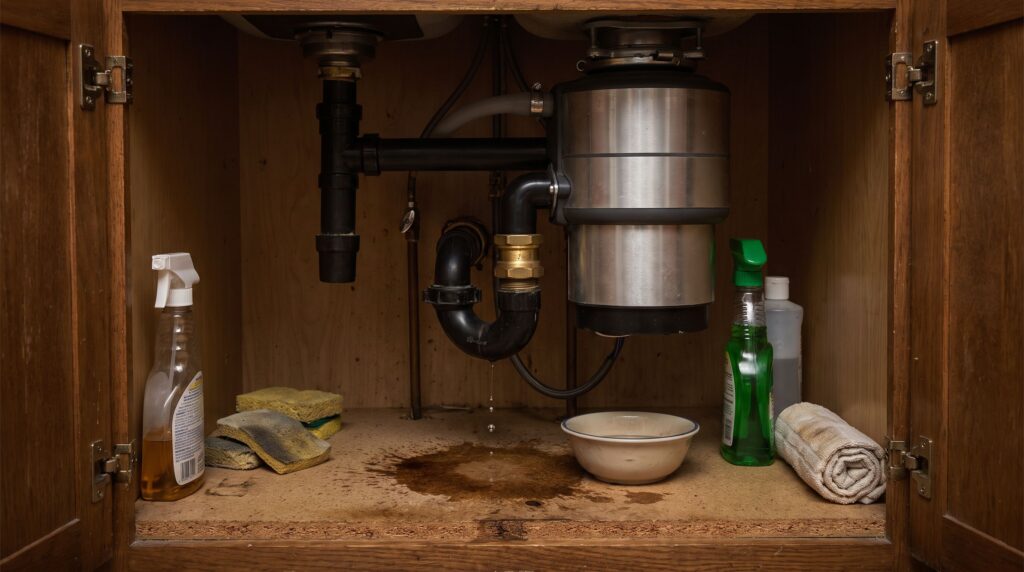
A leaking garbage disposal (garburator) can drip water under your sink slowly enough that you don’t notice until there’s cabinet damage or mould growing on the floor of the cabinet. When you do discover a leak, the location of the drip tells you almost exactly which component has failed — making garbage disposal leaks one of the easier plumbing repairs to diagnose.
This guide covers every leak location, what causes it, and what’s involved in fixing it. Tricity Repairs serves Coquitlam, Port Coquitlam, and Port Moody for garburator repairs.
Step One: Find the Leak Location
Dry the exterior of the disposal unit completely, then run water and watch carefully to identify where drops are forming. The three main leak zones — top, side, and bottom — each point to a different component:
Leaking from the Top (Where the Disposal Meets the Sink)
A leak at the very top of the unit — where the disposal connects to the sink drain flange — is caused by a failed putty seal. When a disposal is installed, the drain flange (the metal ring visible in your sink) is sealed with plumber’s putty and held in place by mounting hardware. Over time, this putty can dry out and crack, or the mounting hardware can work loose — particularly if the disposal has been bumped or if the unit has vibrated excessively over years of use.
Fix: Disconnect the disposal, remount the drain flange with fresh plumber’s putty, and reinstall. This is a DIY-friendly repair. For more on garburator troubleshooting, see: Garburator Not Working? How to Reset and Unclog It.
Leaking from the Side
Side leaks occur at one of two hose connections:
- The dishwasher drain hose connection: If you have a dishwasher, it typically drains into the side of the disposal via a rubber hose and a hose clamp. If the clamp has corroded or loosened, or the rubber hose has cracked, it leaks at this connection point. Tighten the clamp or replace the hose.
- The drain line connection: The disposal connects to the P-trap drainpipe via a discharge tube held by a slip nut and washer. If the washer has deteriorated or the nut is loose, water leaks here during use. Tighten the slip nut or replace the washer.
Leaking from the Bottom
A leak from the very bottom of the disposal unit — the base of the motor housing — indicates a failed internal seal. Inside every disposal, a shaft seal prevents water from the grinding chamber from reaching the motor. When this seal wears out (which happens after years of use or following a jam), water drips from the motor’s reset button or directly from the bottom of the unit.
An internal seal failure typically means the disposal needs replacement rather than repair — the seal isn’t a standard serviceable part, and the labour cost of disassembling the motor to replace it usually exceeds the cost of a new unit. Most disposals last 8–12 years; a bottom leak near the end of that lifespan is a clear sign it’s time to replace the unit.
Leaking After a Jam or Reset
If the leak started right after a jam, the disposal may have overheated and the internal seal may have been damaged by the heat and vibration. Check the reset button on the base and press it to restore power, but also inspect for active leaking before running the unit again. See: Appliance Error Codes and Troubleshooting.
DIY vs Professional Repair
Top leaks (putty seal) and side leaks (hose connections) are accessible repairs for handy homeowners — they require basic tools and replacement parts available at any hardware store. Bottom leaks almost always mean replacement. If you’re not comfortable with the repair or the leak is actively dripping onto cabinet contents, Tricity Repairs serves Coquitlam, Port Coquitlam, and Port Moody — call us at (604) 359-5952.
Summary
Where a garbage disposal leaks tells you what’s wrong: top leaks mean a failed sink flange seal, side leaks mean a loose hose connection, and bottom leaks mean an internal shaft seal failure that typically requires unit replacement. Top and side leaks are straightforward fixes; bottom leaks are usually a signal to replace the disposal, especially if it’s over 8 years old.