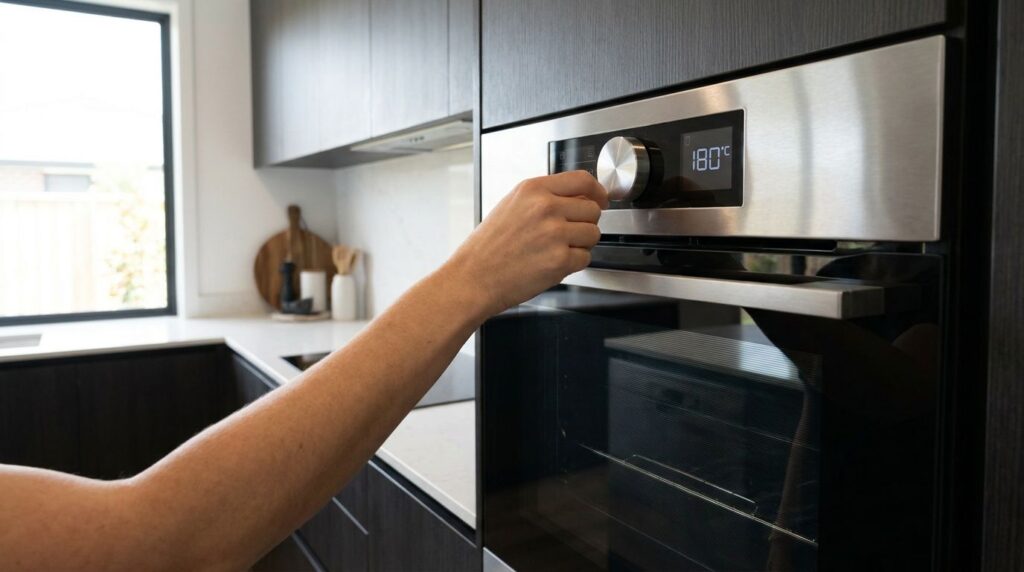
You set the oven to 375°F, go do something else, and come back 20 minutes later to find it still hasn’t reached temperature. Or it eventually gets there, but takes twice as long as it used to. A slow-preheating oven wastes time and energy, and it’s often a sign of a component that’s beginning to fail. The good news is that slow preheating has a manageable set of causes, most of which are diagnosable without opening a single panel.
This guide covers every reason an oven might take too long to preheat, how to identify the cause, and what your options are. Tricity Repairs serves Coquitlam, Port Coquitlam, and Port Moody for all oven repairs.
What “Normal” Preheat Time Looks Like
Most electric ovens take 10–15 minutes to reach 175°C (350°F) and 15–20 minutes to reach 230°C (450°F) under normal conditions. Gas ovens typically preheat slightly faster — around 8–12 minutes to 175°C. If your oven is consistently taking 25–40 minutes or more to reach these temperatures, something is working below capacity.
Common Causes of Slow Oven Preheating
1. Weak or Partially Failed Bake Element (Electric Ovens)
The bake element at the bottom of the oven does most of the work during preheat. When it begins to fail — developing a break or a section that no longer conducts electricity properly — it operates at reduced capacity. The oven still heats, but significantly more slowly than when the element was fully functional. You may notice the element no longer glows uniformly red across its full length, or that one section appears darker or cool.
A partially failed element typically still passes a continuity test because current can still flow through the intact sections. Visual inspection (looking for uneven glowing, dark spots, or visible damage) is more revealing. A fully failed bake element causes the oven not to heat at all rather than heating slowly. For related oven issues, see: Oven Won’t Turn On? Simple Steps to Diagnose It.
2. Oven Calibration Is Off
If the oven’s temperature sensor is misreading the cavity temperature, the control board may not be pushing the heating element as hard as it should during preheat. For example, if the sensor reads 200°F when the actual temperature is only 150°F, the oven will slow its heating earlier than it should, causing a longer-than-normal time to reach the actual set temperature.
Test with a separate oven thermometer: place it in the centre of the middle rack and check the actual temperature at the point the preheat indicator signals it’s ready. If the thermometer reads significantly lower, the temperature sensor needs testing or the thermostat needs calibration. For more detail, see: Oven Temperature Not Accurate? Here’s Why and How to Fix It.
3. Worn Door Gasket or Poor Door Seal
The oven door gasket creates a seal that keeps heat inside the cavity during preheat and cooking. A hardened, cracked, or displaced gasket allows heat to escape continuously — the heating element has to work harder and longer to compensate, making preheat noticeably slower. You may be able to feel warmth around the door edge during preheat if the seal is compromised.
Inspect the gasket by running your fingers around its full perimeter. It should be soft and pliable, sitting flush in its channel with no gaps or hardened sections. Replace if worn. Door gasket replacement is one of the simplest oven repairs.
4. Convection Fan Not Working (Convection Ovens)
In convection mode, the fan circulates hot air throughout the oven cavity, dramatically speeding up preheat and cooking times. If the convection fan motor has failed or is running slowly, the oven relies only on radiant heat from the elements — which is significantly slower. If your oven used to preheat quickly on convection but now performs like a conventional oven, the convection fan motor may have failed.
5. Broil Element Not Contributing to Preheat
Many electric ovens use both the bake and broil elements simultaneously during preheat to reach temperature quickly. If the broil element has failed, the oven loses roughly half its heating capacity during preheat — resulting in significantly slower warmup times even though the oven will still eventually reach temperature using only the bake element. This is a common cause of slow preheat that isn’t immediately obvious because the oven still “works.”
6. Gas Igniter Weakening (Gas Ovens)
In gas ovens, the igniter doesn’t just spark — it’s a glow igniter that heats until it’s hot enough to open the gas valve and sustain combustion. As igniters age, they weaken and take longer to reach the temperature needed to open the gas valve. This extends the time between the oven being turned on and gas actually flowing and burning — making preheat noticeably slower. A weakening igniter will also cause the burner to cycle on and off more frequently during cooking.
7. Voltage Issues (Electric Ovens)
Electric ovens require a 240V circuit to operate at full capacity. If one leg of the 240V circuit has a problem — a partially failed breaker, a loose connection at the outlet, or a wiring issue — the oven may receive only 120V. At half voltage, heating elements operate at dramatically reduced capacity and preheat takes much longer. Check the circuit breaker for your oven and confirm both breakers in the double-pole breaker are fully engaged.
Step-by-Step Diagnosis
- Time the preheat and compare to the manufacturer’s specification for your model.
- Use an oven thermometer — does the actual temperature match the set temperature when preheat completes?
- Visually inspect both elements (bake and broil) — do they both glow fully and uniformly?
- Check the door gasket — feel for heat escaping around the door edge during preheat.
- Check the circuit breaker (electric ovens) — confirm the double-pole breaker is fully on.
- Test convection fan — does it spin during convection preheat?
For comprehensive oven maintenance, see: How to Maintain Your Oven and Prevent Costly Repairs.
When to Call a Professional
If a visual element inspection doesn’t reveal obvious damage and temperature calibration checks out, the issue may be a partially failed element (requires meter testing), a failing igniter (gas), or a voltage issue — all of which benefit from professional diagnosis. Tricity Repairs serves Coquitlam, Port Coquitlam, and Port Moody. Call us at (604) 359-5952 for a fast oven diagnosis.
Summary
A slow-preheating oven is most commonly caused by a weakening bake element, a miscalibrated temperature sensor, a failing door gasket, or — in ovens that use both elements to preheat — a failed broil element. Test with an oven thermometer, inspect elements visually, and check the door seal. Most causes are fixable with an affordable replacement part, and addressing them early prevents further efficiency loss.