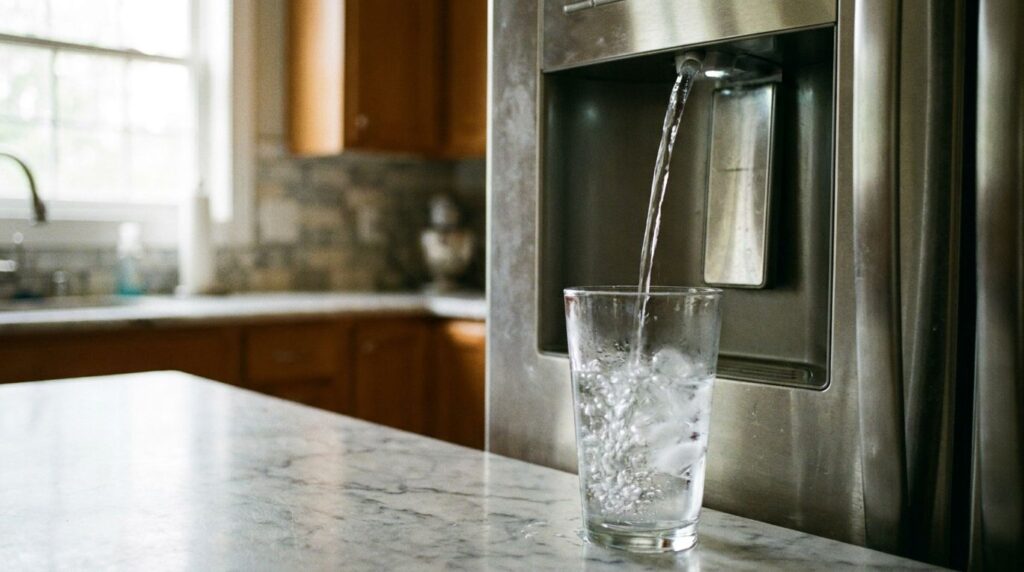
The water dispenser on your refrigerator is one of those features you don’t appreciate until it stops working. Whether it’s dispensing a trickle, dispensing nothing at all, or making a loud humming noise without producing water, a non-functioning dispenser has a manageable set of causes. Most of them don’t require a technician — but knowing how to work through them systematically saves time and frustration.
This guide covers every reason a refrigerator water dispenser might stop working, how to diagnose the issue, and when professional repair makes sense. Tricity Repairs serves Coquitlam, Port Coquitlam, and Port Moody for all refrigerator repairs.
How the Water Dispenser Works
When you press the dispenser lever or paddle, a micro switch sends a signal to the control board, which opens the water inlet valve. Water flows from your home supply line, through a water filter, into a chilled reservoir or directly to the dispenser outlet, and out through the dispenser nozzle. The entire system depends on adequate water pressure, a functioning inlet valve, an unobstructed filter and water line, and working switches and control logic.
Common Causes of a Non-Working Water Dispenser
1. Water Supply Line Is Turned Off or Kinked
Start with the simplest possibility. The water supply line that feeds your refrigerator runs from a saddle valve or shut-off valve (usually under the sink or behind the fridge). If this valve is partially or fully closed — perhaps after kitchen work or the fridge being moved — no water reaches the dispenser.
Also check the supply line itself (usually a thin copper or braided hose running behind the fridge) for kinks. Even a slight kink can restrict flow to a trickle. Pull the fridge away from the wall carefully and inspect the full length of the line.
2. Frozen Water Line Inside the Freezer
This is one of the most common causes of a refrigerator dispenser that suddenly stops working, especially if the freezer temperature is set very low. A small section of the water line runs through or near the freezer compartment to keep water cold. If the freezer is too cold (below -18°C / 0°F), this section can freeze, blocking flow completely.
To test: unplug the fridge and leave the freezer door open for a few hours to allow the line to thaw. If the dispenser works afterward, raise the freezer temperature slightly and check the freezer thermostat. A defrost system problem can also contribute to this — ice buildup can encase the water line.
3. Clogged or Expired Water Filter
Most refrigerators with dispensers have an in-line water filter that removes sediment and contaminants. These filters need replacing every 6 months. When a filter becomes severely clogged, it restricts water flow to the dispenser significantly — you might get a trickle instead of a full stream, or nothing at all. Some fridges will also lock out the dispenser when the filter life indicator signals replacement is overdue.
Replace the filter and check whether flow improves. If you’ve never replaced the filter, it’s definitely due. Also check that the replacement filter is properly seated — a partially inserted filter can block flow entirely.
4. Failed Water Inlet Valve
The water inlet valve is an electrically operated solenoid valve that opens when the dispenser is activated. When the solenoid coil fails or the valve screen becomes clogged, water either stops flowing or flows very weakly. A characteristic sign of a failing inlet valve is a loud buzzing or humming from the back of the fridge when you press the dispenser — the valve is receiving power but can’t open properly.
The inlet valve can be tested with a multimeter for continuity. A clogged screen can sometimes be cleaned; a failed solenoid requires valve replacement. This is a moderate-difficulty DIY repair or a quick job for a technician. For related fridge troubleshooting, see: Refrigerator Running But Not Cooling? Here’s Why.
5. Faulty Dispenser Switch or Actuator
The dispenser paddle or lever activates a micro switch that signals the control board to open the inlet valve. If this switch fails, pressing the lever produces no response — no water, no ice, no motor sound. You can test the switch with a multimeter for continuity when pressed. A stuck or broken dispenser lever can also fail to fully engage the switch.
6. Control Board Issue
The dispenser control board (separate from the main fridge control board on some models) manages the dispenser functions. A failed board can cause the dispenser to stop responding entirely, behave erratically, or fail only for water while still dispensing ice (or vice versa). Control board issues are diagnosed after ruling out all simpler causes.
7. Child Lock Activated
Many modern refrigerators have a child lock or control lock feature that disables the dispenser to prevent accidental use. If the dispenser suddenly stopped working with no other symptoms, check whether the child lock is engaged — usually indicated by a lock icon on the display. The method to disable varies by brand; check your manual.
8. Low Water Pressure
Refrigerator water dispensers require a minimum supply pressure — typically 20 PSI. If your home’s water pressure is too low, the inlet valve won’t open fully and the dispenser produces a trickle or nothing. Test pressure at a nearby tap. If pressure seems low throughout the home, the issue is with your supply rather than the fridge.
Step-by-Step Troubleshooting
- Check child lock — is the lock feature activated on the control panel?
- Check the supply valve behind or under the fridge — is it fully open?
- Replace the water filter if it’s over 6 months old or the indicator light is on.
- Check for a frozen water line — unplug and allow to thaw for a few hours.
- Listen when pressing the dispenser — buzzing with no water = likely inlet valve. Silence = switch or control board.
- Inspect the supply line for kinks behind the fridge.
For more on refrigerator maintenance, see: Common Refrigerator Mistakes That Lead to Costly Repairs.
When to Call a Professional
If you’ve replaced the filter, confirmed the supply is on, thawed the line, and the dispenser still doesn’t work — the inlet valve, dispenser switch, or control board likely needs professional diagnosis. Tricity Repairs serves Coquitlam, Port Coquitlam, and Port Moody with refrigerator repair. Call us at (604) 359-5952 for a fast diagnosis. Also check: How to Inspect and Replace Your Refrigerator Door Gasket for related fridge maintenance tips.
Summary
A refrigerator water dispenser that stops working is most often caused by a closed supply valve, a frozen water line, an expired filter, or a failed inlet valve. Work through the free checks first — child lock, supply valve, filter replacement, and thawing the line. These resolve the majority of dispenser problems without any parts cost. For persistent issues, a technician can test the inlet valve and control components quickly.