A washing machine that won’t drain is one of the more frustrating appliance problems — you open the lid or door to find a tub full of water and soaking wet clothes with nowhere to go. The good news is that most drainage failures have a short list of causes, and several are fixable without calling a technician. This guide walks through each cause in order of likelihood, so you can diagnose the problem methodically and get back to clean laundry.
Tricity Repairs serves Coquitlam, Port Coquitlam, and Port Moody for all washing machine repairs.
Before You Start: Safety First
Before inspecting or accessing internal components, unplug the washing machine. Water and electricity are a dangerous combination. Place towels around the machine and have a shallow pan ready — you’ll likely need to manually drain the remaining water before you can access the pump or filter.
Common Causes of a Washing Machine That Won’t Drain
1. Clogged Pump Filter (Front-Loaders)
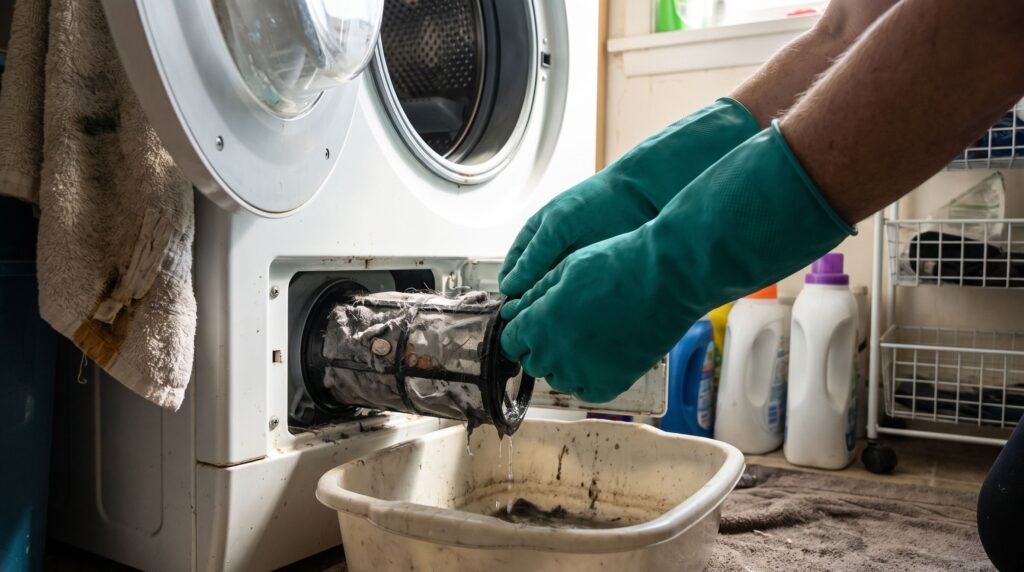
Front-load washing machines have an accessible pump filter — usually behind a small panel at the lower front of the machine. This filter catches lint, coins, bobby pins, and other small objects that would otherwise damage the pump. When it becomes clogged, water can’t flow through to drain. This is the most common cause of drainage problems in front-loaders and the easiest to fix.
To clean it: place a towel and shallow pan under the access panel, twist out the filter cap slowly to let water drain, remove any debris, rinse the filter, and reinstall securely. Run a spin/drain cycle to test. Clean this filter every 1–3 months as part of routine maintenance.
2. Blocked or Kinked Drain Hose
The drain hose carries water from the pump to your home’s standpipe or laundry sink. If it’s kinked (often caused by the machine being pushed too close to the wall), partially blocked by a sock or debris, or inserted too far into the standpipe creating a siphon, water won’t drain properly. Pull the machine away from the wall, inspect the hose along its full length for kinks, and verify the hose end is only 15–20cm (6–8 inches) into the standpipe — not sealed in tightly.
3. Failed Drain Pump
The drain pump is the motor that actively pushes water out through the drain hose. When it fails — either from a seized motor, burned-out windings, or a foreign object jamming the impeller — the machine won’t drain at all. You may hear a humming sound (motor trying to run but jammed) or complete silence where you’d normally hear the pump.
With the filter access panel open, you can often see and manually turn the pump impeller (the fan-like component behind the filter). It should turn freely. If it’s stuck, there may be debris jamming it. If the motor runs but the impeller doesn’t turn, the pump needs replacement. For related issues, see: How to Prevent Washing Machine Flooding.
4. Lid Switch or Door Latch Failure
On top-load washers, the lid switch is a safety device that tells the machine the lid is closed. If the lid switch has failed, the machine may fill and agitate but skip the drain and spin cycle entirely — leaving clothes sitting in water. The switch is typically located under the lid near the hinge. You can test it by pressing it manually (with the machine unplugged, then plugged back in) — it should click.
On front-loaders, a faulty door latch that doesn’t fully engage can also prevent the machine from progressing through the drain and spin cycle.
5. Washing Machine Error Code
Most modern washers will display an error code when a drainage fault is detected — common codes include E3, F21, F9E1 (Whirlpool/Maytag), 5E or SE (Samsung), OE (LG), or similar depending on brand. These codes point directly to a drain issue and will appear on the display after the machine fails to drain within its expected time window. For a full guide to error codes, see: Appliance Error Codes: The Ultimate Cheat Sheet.
6. Control Board or Timer Fault
The control board (or mechanical timer on older machines) sequences the wash cycle, including triggering the drain pump at the right time. If the control board has failed or a timer motor is stuck, it may not send the signal to the pump to drain. This is typically diagnosed after ruling out all physical causes — pump, hose, filter, and lid switch all test fine, but the machine still won’t drain on command.
How to Manually Drain Your Washing Machine
While you diagnose the problem, you’ll need to get the water out. Options include:
- Front-loaders: Use the pump filter access drain — remove the filter cap slowly to let water drain into the pan in batches.
- Top-loaders: Lower the drain hose below the water level of the machine into a bucket, allowing gravity to drain it. Be ready to lift the hose to stop flow when the bucket is full.
- On some machines, selecting “spin only” or “drain and spin” — if the pump is partially working — will force a drain attempt.
When to Call a Technician
If cleaning the filter and checking the hose don’t resolve the problem, the drain pump or lid switch likely needs replacing — both require accessing internal components. Tricity Repairs serves Coquitlam, Port Coquitlam, and Port Moody. Call us at (604) 359-5952 for washing machine drainage repair. For more maintenance tips, see: How to Maintain Your Washing Machine.
Summary
A washing machine that won’t drain is most often caused by a clogged pump filter (especially on front-loaders), a kinked or blocked drain hose, or a failed drain pump. Check the filter first — it’s accessible without tools and resolves the problem in many cases. If that doesn’t fix it, inspect the drain hose and lid switch before moving on to the pump itself.