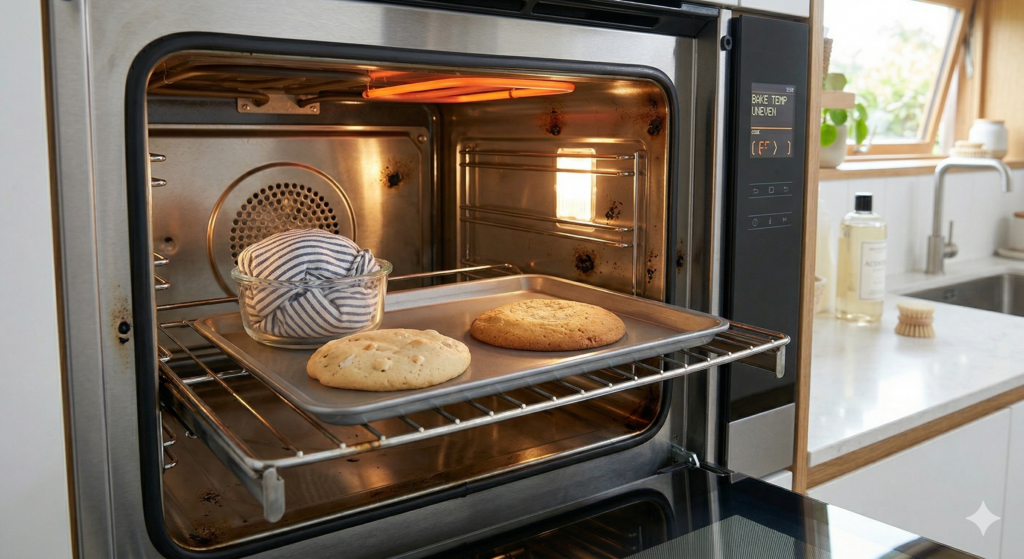
You follow a recipe perfectly — right temperature, right rack position, right timing — and still pull out cookies that are burned on one edge and pale on the other, or a cake that’s risen beautifully on one side and sunken on the other. Uneven baking is one of the most frustrating oven problems because it seems random, but it almost always has a diagnosable cause. The good news: most of the reasons ovens bake unevenly are fixable, and some don’t require a technician at all.
In this guide, we’ll walk through every common cause of uneven baking results, how to identify which one is affecting your oven, and what you can do about it. If you’re in Coquitlam, Port Coquitlam, or Port Moody, Tricity Repairs can diagnose and fix oven problems quickly.
Why Even Baking Is Hard to Achieve
Ovens work by generating heat — from a bake element at the bottom, a broil element at the top, or both — and circulating it through the cavity to maintain a consistent temperature. Even in a perfectly functioning oven, temperature can vary slightly across the cavity. But when you’re getting dramatically different results on different sides of the same pan, something is wrong with how heat is being generated or distributed.
How to Test for Hot Spots
Before diving into causes, confirm you actually have a hot spot problem rather than a technique issue. The classic bread test works well: lay slices of white sandwich bread in a single layer across a baking sheet, covering as much of the surface as possible. Bake at 375°F for about 10 minutes and observe the browning pattern. Dark spots indicate hot zones; pale spots indicate cooler areas.
If the browning is dramatically uneven — one side dark, one side barely toasted — you have a hot spot issue. If browning is relatively even but overall too dark or too light, you may have a calibration problem (oven running hotter or cooler than the set temperature).
Common Causes of Uneven Baking
1. Faulty or Partially Failed Bake Element
In electric ovens, the bake element is the coiled heating element at the bottom of the oven cavity. When this element is functioning correctly, it glows red and generates consistent heat across its full length. When it starts to fail — through a partial break, a burned-out section, or corrosion — only part of the element heats up. This creates dramatically uneven heat in the oven, with the area near the working section of the element running very hot while the rest of the oven stays cooler.
Visually inspect the bake element when the oven is cold and unplugged. Look for any visible cracks, holes, burn marks, or blistering along the coil. A healthy element should look uniform. If you see damage, the element needs replacement — this is one of the more straightforward oven repairs and can make a dramatic improvement in baking performance.
You can also test the element with a multimeter for continuity — a working element will show resistance (typically 20–60 ohms depending on model). No continuity means it has failed.
2. Oven Temperature Calibration Is Off
Ovens drift out of calibration over time — meaning the temperature displayed on the control panel may be 15°C, 25°C, or even more off from the actual temperature inside the cavity. An oven running 25°C hotter than set will burn the outside of baked goods before the interior is cooked; one running cold will undercook or produce flat results.
Test your oven’s accuracy with a dedicated oven thermometer placed in the centre of the middle rack. Set the oven to 175°C (350°F) and let it fully preheat — then wait an additional 15 minutes for the temperature to stabilize. Compare the thermometer reading to the set temperature. If it’s consistently off by more than 10°C, calibration adjustment is needed.
Many ovens allow user calibration through the control settings — check your manual. If yours doesn’t have this feature, or the offset is very large, a technician can recalibrate the thermostat.
3. Oven Door Seal (Gasket) Is Worn or Damaged
The rubber gasket around the oven door keeps heat inside the cavity during baking. When this seal cracks, hardens, or pulls away from the door frame, heat escapes from specific points around the door — creating cool spots near those areas while the rest of the oven runs hotter to compensate. This causes uneven baking, particularly for items placed near the front of the oven.
Inspect the door gasket by running your fingers around its full perimeter when the oven is cold. Feel for hardness, cracks, or sections that have pulled away. You can also feel for heat escaping around the door while the oven is running (carefully). A worn gasket is an inexpensive replacement and significantly improves baking consistency. For more on oven door issues, see our guide: Oven Won’t Turn On? Simple Steps to Diagnose It.
4. Rack Position and Pan Choice
Before assuming a mechanical fault, consider whether rack position and bakeware are contributing to uneven results. Heat in most ovens is hottest at the bottom (from the bake element) and hottest at the top during broil. The middle rack is designed to be the most balanced position for most baking.
Additionally, dark metal pans absorb more heat and cause faster browning on the pan-contact side. Glass and ceramic retain heat differently than aluminium. Thin baking sheets warp at high temperatures, causing items to slide toward the low side and bake unevenly. If you’re consistently getting uneven results with a particular pan, the pan itself may be the culprit — not the oven.
5. Convection Fan Issues (Convection Ovens)
If your oven has a convection setting, it uses a fan at the back of the oven to circulate hot air for more even baking. When this fan motor is failing or the fan blade is obstructed, air circulation is reduced or eliminated — and you may actually get worse hot spots than in a conventional oven, because the heating element’s radiant heat isn’t being distributed.
Signs of a convection fan problem include the fan running noticeably louder than usual, the fan running slowly or stopping mid-cycle, or baking results that are visibly worse on convection than conventional mode. A technician can test the fan motor and replace it if needed.
6. Oven Not Fully Preheated
One of the most common causes of uneven baking is simply not waiting long enough for the oven to fully preheat. When the oven signals it’s at temperature (with a beep or indicator light), the air in the cavity may have reached the set point, but the oven walls, racks, and cavity itself may still be cooler. Putting food in at this moment means it goes into a cavity that still has significant temperature variation.
As a general rule, after the preheat signal, wait an additional 10–15 minutes before placing food inside. This allows thermal mass to fully stabilize. An oven thermometer will show you exactly when temperature has settled.
7. Obstructed Airflow Inside the Oven
Ovens rely on natural convection — hot air rising, cool air sinking — to distribute heat through the cavity. When racks are overloaded, multiple pans block airflow between shelves, or a large pan covers most of the oven floor, this convection is disrupted and hot spots form. For best results, leave space between pans and between pans and the oven walls. Avoid lining the oven floor with foil, which blocks heat from the bake element.
8. Temperature Sensor Malfunction
Modern electronic ovens use a temperature sensor (similar to a thermistor) to monitor oven cavity temperature and adjust heating accordingly. If this sensor is reading incorrectly, the oven may cycle on and off at the wrong times — running too hot, too cold, or with wide temperature swings that cause uneven baking.
A failing sensor often causes the oven temperature to fluctuate noticeably — you might see the oven light cycling on and off more frequently than usual, or notice that baking results vary significantly from one batch to the next even with identical settings. Sensors can be tested with a multimeter and are relatively affordable to replace.
Step-by-Step Troubleshooting
- Run the bread test to confirm and map the hot spots.
- Check oven calibration with an oven thermometer — test at 175°C and 205°C (350°F and 400°F).
- Inspect the bake element visually for damage and test with a multimeter.
- Check the door gasket for cracks, hardness, or gaps.
- Review rack position and pans — try the middle rack with a light-coloured aluminium pan.
- Allow full preheat time — wait 15 minutes after the preheat signal.
- If convection-equipped, check the fan is running at full speed.
Quick Wins That Often Help Immediately
Even without any repairs, a few adjustments can improve baking consistency right away: rotating your pans halfway through the bake time, using an oven thermometer to compensate for calibration offset, moving to the centre rack for everything, and using lighter-coloured pans. These won’t fix an underlying mechanical problem, but they can produce noticeably better results while you arrange a repair.
For more on oven maintenance and care, see: How to Deep Clean Your Oven Without Chemicals.
When to Call a Professional
If the bread test shows significant hot spots even after you’ve confirmed good preheat time and proper rack use, a component is likely failing. Bake element, temperature sensor, and convection fan motor replacements are all manageable repairs that a technician can complete in a single visit — often restoring baking performance to like-new quality.
Tricity Repairs serves Coquitlam, Port Coquitlam, and Port Moody with expert oven repair. We carry parts for all major brands including Samsung, LG, Whirlpool, Frigidaire, Bosch, and GE. Call us at (604) 359-5952 and we’ll diagnose what’s causing your uneven baking results. You can also review whether repair makes sense for your specific appliance at our Repair vs. Replace guide.
Summary
Uneven baking is almost always caused by one of a handful of diagnosable problems: a partially failed bake element, a miscalibrated thermostat, a worn door gasket, a struggling convection fan, or simply not allowing enough preheat time. Start with the free checks — the bread test, an oven thermometer, and a door gasket inspection — before moving to component replacement. Addressing the root cause will save you from compensating with workarounds every time you bake.