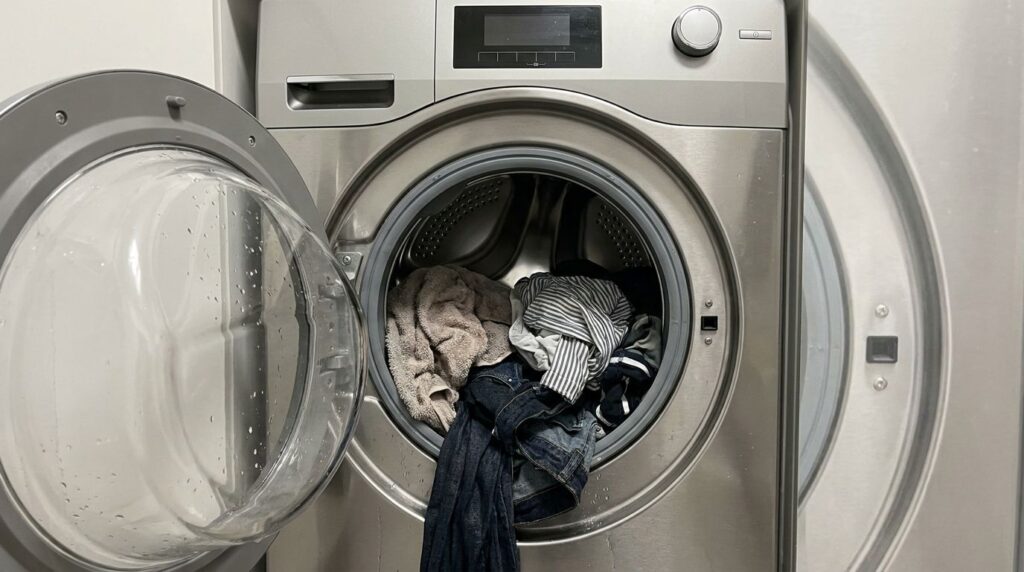
You start a wash cycle, walk away to do something else, and come back to find a drum full of soggy clothes sitting in water — the machine has stopped completely. Or maybe you hear it fill and agitate, then nothing. A washing machine that stops mid-cycle is one of those problems that feels urgent because your laundry is literally stuck inside, but it almost always has a diagnosable cause with a clear fix.
This guide covers every common reason a washing machine stops mid-cycle, how to identify which one you’re dealing with, and what to do next. If you’re in Coquitlam, Port Coquitlam, or Port Moody, Tricity Repairs can get your machine running again quickly.
Step One: Try a Reset First
Before diagnosing anything, try a full reset. Unplug the washing machine from the wall, wait 60 seconds, and plug it back in. Many modern washers have electronic control boards that can get stuck in a fault state — especially after a power surge or interruption — and a full reset clears these temporary faults. If the machine completes the next cycle normally, you had a software glitch rather than a mechanical issue. For more on resets, see: How to Reset Any Appliance.
Common Causes of a Washer Stopping Mid-Cycle
1. Unbalanced or Overloaded Load
This is the single most common cause of a washing machine stopping mid-cycle — and it’s immediately fixable. Modern washers have sensors that detect when a load is unbalanced during the spin cycle. If clothes shift to one side of the drum, the machine detects the imbalance and stops to prevent damage from the violent shaking that would result from spinning an unbalanced load.
Open the machine, redistribute the clothes evenly around the drum, and restart the cycle from the spin phase. If this happens frequently, you may be overloading the drum, washing a single heavy item (a duvet, jeans, or a towel) without balancing it with other items, or running fast spins with a mismatched load.
2. Lid Lock or Door Latch Failure
Top-load washers won’t advance through spin if the lid lock isn’t engaged. Front-load washers won’t run at all without a locked door. If the lid lock or door latch fails mid-cycle — perhaps due to a vibration jarring it loose, or an intermittent electrical fault in the latch circuit — the machine will stop immediately as a safety measure.
On top-loaders, listen for the click of the lid lock engaging when the cycle starts. If the machine stops at the same point in the cycle consistently, the lid lock may have a failing solenoid. On front-loaders, check that the door is fully latched and that the door seal isn’t preventing full closure. For more, see our guide: Washing Machine Lid Lock Not Working?.
3. Drainage Problem
If the washing machine can’t drain at the end of the wash cycle, it won’t advance to the spin cycle — and many machines will display an error code and stop entirely. A clogged pump filter, a blocked drain hose, or a failing drain pump can all cause this.
Check the pump filter first (on front-loaders, it’s usually behind a small panel at the bottom front of the machine). Remove any lint, coins, or debris. Also check that the drain hose at the back hasn’t kinked or become submerged too deeply in the standpipe (which can create a siphon that prevents draining). For a full guide, see: Dishwasher Not Draining: Troubleshooting Guide for general appliance drainage principles.
4. Water Supply Issue
If the machine stops during the fill phase — very early in the cycle — it may not be receiving adequate water. The machine will wait up to a set time limit for the tub to fill, and if it doesn’t receive enough water, it aborts the cycle. Check that the hot and cold supply valves behind the machine are fully open, and that the inlet screens aren’t clogged. Low household water pressure during peak hours can also cause this.
5. Overheating Motor
The drive motor has a built-in thermal overload protector that cuts power if the motor overheats. Causes include consistently overloaded drums, washing very heavy items (canvas, denim, large duvets) repeatedly, or a motor that’s simply wearing out. The machine will stop mid-cycle, sometimes after a burning smell, and refuse to restart until the motor cools down (usually 30–60 minutes).
If the machine regularly stops mid-cycle and restarts after sitting for an hour, motor overheating is the likely cause. Addressing overloading habits helps immediately; a motor that’s worn to the point of overheating on normal loads will need professional assessment.
6. Control Board Malfunction
The main control board manages cycle sequencing — it tells the machine when to fill, agitate, drain, and spin. A faulty control board can interrupt any phase of the cycle, sometimes randomly and sometimes consistently at the same point. Control board issues are often accompanied by erratic behaviour across multiple cycles, error codes that don’t match obvious problems, or functions that work intermittently.
Control board diagnosis requires ruling out all simpler causes first. A technician can test the board’s outputs and determine whether replacement is needed.
7. Faulty Water Level Sensor (Pressure Switch)
The pressure switch monitors the water level in the drum. If it malfunctions and sends incorrect signals to the control board — for example, indicating “full” when the machine has barely filled, or “empty” when the machine is full of water — the cycle logic can get confused and stop mid-cycle. A failing pressure switch can also cause the machine to overfill, underfill, or drain unexpectedly during the cycle.
8. Power Supply Issues
Don’t overlook the electrical supply. A washing machine drawing high current during the spin cycle can trip a circuit breaker, especially on an older or overloaded circuit. Check your breaker panel if the machine stops suddenly with no warning — a tripped breaker is a straightforward fix, though it’s worth having an electrician assess the circuit if it trips repeatedly.
Interpreting Error Codes
Most modern washing machines display error codes when they stop unexpectedly. These codes are model-specific but follow general patterns across brands:
- Drainage codes (E3, F21, 5E, etc.): The machine couldn’t drain. Check the filter and drain hose.
- Lid/door codes (Lid, dL, F34, etc.): The lid lock or door latch isn’t engaging.
- Unbalance codes (UE, Ub, F0E5, etc.): Load is unbalanced. Redistribute and restart.
- Water supply codes (LF, F8E1, 4E, etc.): Filling too slowly or not at all.
Check your machine’s manual or search the brand + error code online for specific guidance.
When to Call a Professional
If the reset didn’t help, the load is balanced, the filter is clear, and the machine keeps stopping at the same point in the cycle — it’s time for a professional diagnosis. A technician can test the lid lock, drain pump, water level sensor, and control board systematically to identify the failing component.
Tricity Repairs serves Coquitlam, Port Coquitlam, and Port Moody with washing machine repair. Call us at (604) 359-5952 for a same-week service appointment. For more washer troubleshooting, see: Signs Your Washing Machine Needs Repair.
Summary
A washing machine that stops mid-cycle is most often caused by an unbalanced load, a lid lock or door latch issue, a drainage problem, or a software glitch cleared by a reset. Work through the free fixes first: reset, rebalance the load, clean the pump filter, and check the supply valves. If the problem persists, a technician can accurately diagnose whether the control board, motor, water level sensor, or another component needs attention.