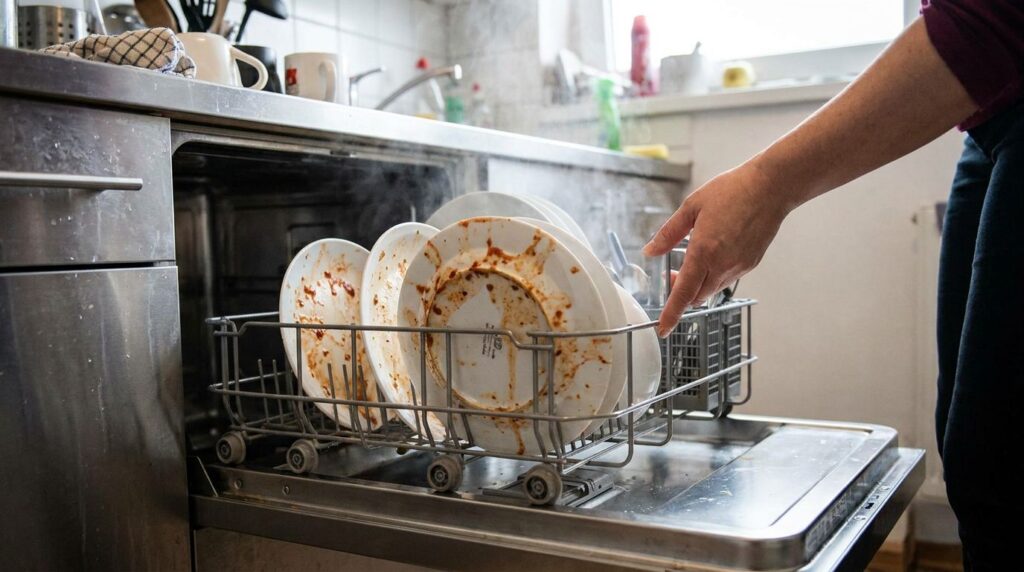
You run a full dishwasher cycle, open the door expecting clean dishes, and find bits of food still stuck to plates, glasses with gritty residue, or brown flecks that weren’t there before loading. A dishwasher that leaves food on dishes is failing at its basic job — and it’s one of the most common complaints homeowners have about their machines. The causes range from something as simple as how you loaded the rack to a failing wash pump, and knowing the difference is the key to fixing it efficiently.
This guide covers every reason a dishwasher might leave food residue on dishes, how to identify which issue you’re dealing with, and what to do. Tricity Repairs serves Coquitlam, Port Coquitlam, and Port Moody for all dishwasher repairs.
1. Dishes Loaded Incorrectly
Loading technique matters more than most people realize. Bowls and cups facing up trap water and food debris rather than allowing it to drain. Plates stacked too close together prevent water from reaching between them. Tall items blocking the spray arm path mean entire sections of the rack don’t get sprayed. Items nested inside each other (spoons especially) shield each other from water contact entirely.
Best practice: all items should face inward and downward (toward the spray source), with space between each item. Bowls and cups angle downward. Large items go on the sides and back. Nothing should extend below the bottom rack where it might block the lower spray arm rotation.
2. Clogged or Dirty Filter
Modern dishwashers use a manual-clean filter at the bottom of the tub that traps food particles and prevents them from recirculating. When this filter becomes clogged — which happens gradually with regular use — it reduces water pressure throughout the system. Lower pressure means weaker spray arms, which means food doesn’t get washed off dishes properly.
Clean the filter monthly: twist it counterclockwise to remove, rinse under running water, and scrub with a soft brush. If you’ve never cleaned yours, it may be heavily loaded with debris — a contributing factor to food residue on dishes. For more on filter and drainage maintenance, see: Dishwasher Not Draining: Troubleshooting Guide.
3. Clogged Spray Arms
The spray arms distribute pressurized water across all the dishes. Their nozzle holes can become clogged with mineral deposits, food debris, or broken glass fragments — reducing spray coverage and pressure. If dishes on the top rack consistently come out dirtier than the bottom, the middle spray arm is likely partially clogged.
Remove each spray arm and hold it up to the light — you should see through each nozzle hole clearly. Use a toothpick to clear any blocked holes and soak in white vinegar for 15–30 minutes to dissolve mineral scale. See our full guide: How to Clean Your Dishwasher Spray Arm.
4. Water Not Hot Enough
Dishwasher detergent is formulated to work at specific temperatures — typically 49°C to 60°C (120°F to 140°F). If the water entering the dishwasher is too cold (because the water heater is set too low or the supply line runs cold), detergent won’t dissolve or activate properly, and food residue won’t break down. Grease in particular requires hot water to emulsify and rinse away.
Run your kitchen hot tap for 60 seconds before starting the dishwasher to ensure hot water fills the machine immediately. Check your water heater is set to at least 49°C (120°F). Also check whether the dishwasher’s heating element is functioning — a failed element leaves water at whatever temperature it arrived.
5. Too Much or Too Little Detergent
Both extremes cause problems. Too little detergent means insufficient cleaning power — food breaks down partially but isn’t fully removed, leaving residue. Too much detergent in a low-water situation creates excess suds that cushion food particles rather than washing them away, and can leave a soapy film on dishes that traps debris.
Use the amount specified on the detergent packaging for your water hardness level. If you have soft water, you typically need less detergent than the maximum fill line suggests. Fresh detergent also matters — old or clumped powder detergent doesn’t dissolve well and loses cleaning effectiveness.
6. Pre-Rinsing Dishes Too Much
This seems counterintuitive but it’s real: modern dishwasher detergents rely on food soil to activate properly. The enzymes in most dishwasher tablets and powders are triggered by the proteins and starches in food residue — if dishes are perfectly clean going in, the detergent may not activate fully and can leave a film or residue. Scrape large food pieces off plates before loading, but don’t rinse them clean under the tap.
7. Low Water Pressure or Inlet Valve Issue
If the dishwasher isn’t receiving adequate water pressure, the spray arms don’t generate enough force to dislodge food. A partially clogged inlet valve screen or low household water pressure reduces the volume of water entering the machine. If your dishwasher seems to use less water than it used to, or if the spray sounds quieter than normal, water pressure is worth investigating.
8. Failing Wash Pump
The circulation pump forces water through the spray arms at pressure. When the pump motor weakens, water circulates at reduced pressure and spray arms turn slowly — resulting in incomplete cleaning across the whole machine. A gradually weakening pump often presents as declining cleaning performance over several months before it fails entirely. You may notice the wash cycle sounding quieter than it used to.
Step-by-Step: What to Check First
- Clean the filter — remove, rinse, and scrub monthly.
- Clear the spray arm nozzles — check all holes for blockages.
- Check your loading pattern — are all items facing the spray source with space between them?
- Run hot water at the tap first — ensure hot water enters the machine from the start.
- Adjust detergent quantity — use the recommended amount, not more.
- Listen to the wash cycle — does the spray sound strong? Weaker than usual suggests pump or pressure issues.
For more on dishwasher care, see: Dishwasher Drying Tricks That Actually Work.
When to Call a Professional
If cleaning the filter and spray arms, adjusting loading, and checking water temperature don’t improve results, the wash pump or inlet valve may need professional testing. A technician can measure water pressure inside the machine and assess pump performance accurately.
Tricity Repairs serves Coquitlam, Port Coquitlam, and Port Moody. Call us at (604) 359-5952 and we’ll diagnose what’s causing your dishwasher to underperform.
Summary
A dishwasher leaving food residue on dishes is most often caused by a clogged filter, blocked spray arm nozzles, incorrect loading, or water that’s not hot enough — all of which are free to fix. Clean the filter monthly, clear the spray arms quarterly, load correctly, and ensure hot water reaches the machine from the start of each cycle. For persistent issues, the wash pump or inlet valve may need professional assessment.