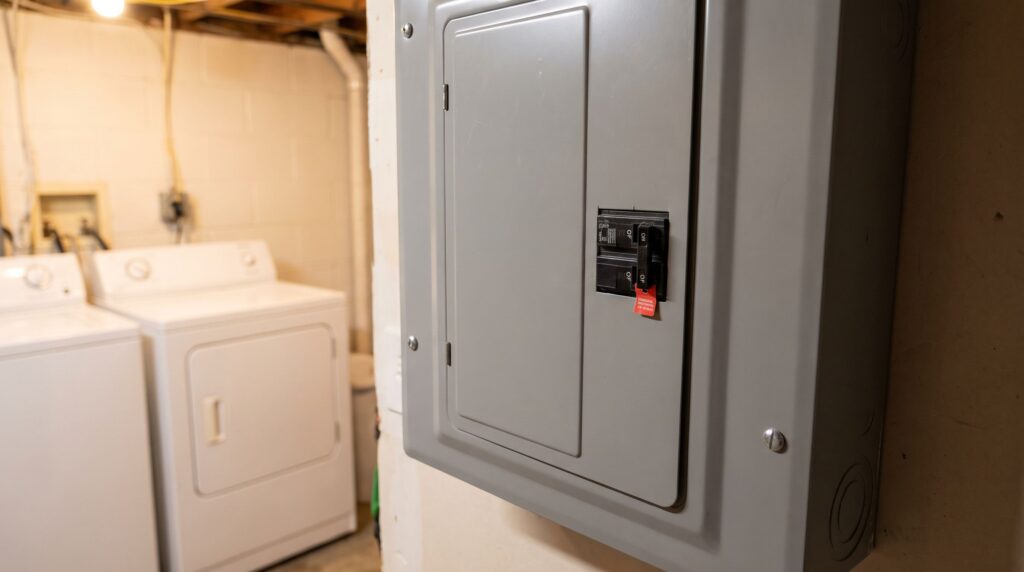
A dryer that repeatedly trips its circuit breaker is more than an annoyance — it’s a warning sign that something is drawing more current than the circuit can safely handle. Unlike a one-time trip that resets and stays on, a dryer that trips the breaker every cycle (or partway through) has an underlying fault that needs to be identified before the breaker fails to protect you. This guide covers every cause, from the simple to the serious.
Tricity Repairs serves Coquitlam, Port Coquitlam, and Port Moody for all dryer repairs.
Why Dryers Trip Circuit Breakers
Electric dryers in Canada typically run on a dedicated 240V, 30-amp circuit. A circuit breaker trips when the current exceeds its rated capacity — either because the dryer is drawing more than 30 amps, or because the breaker itself has weakened and is tripping at lower-than-rated current. Both situations need attention.
Common Causes
1. Clogged or Restricted Exhaust Vent
This is the most frequently overlooked cause. When the dryer vent is blocked with lint, the heating element runs longer and harder to compensate for the lack of airflow, drawing more current and causing excessive heat buildup. This can trip the breaker via the thermal fuse or overload protection — or in some cases, push the heating element itself into overcurrent territory.
Disconnect the vent hose from the back of the dryer and run a cycle with it venting directly (outdoors only, briefly). If the breaker doesn’t trip, the vent is the problem. Clean the full vent duct from the dryer to the exterior exhaust cap. For more on this topic, see: How to Maintain Your Dryer and Prevent Fire Hazards.
2. Failing Heating Element
The heating element in an electric dryer is a coiled resistance wire that heats when current passes through it. When it begins to fail, it can develop a partial short — where the coil touches the housing or another coil turn, reducing resistance and causing a current spike. This spike trips the breaker, often after a few minutes of running when the element heats up and the short point makes contact.
A failing element may show visible damage (burn marks, broken coils) when inspected. It will also fail a continuity test on a multimeter — either no continuity (open/broken) or a short between the element and its casing. Heating element replacement is one of the most common dryer repairs and is cost-effective on most machines.
3. Faulty Thermal Fuse or High-Limit Thermostat
These safety components cut power to the heating circuit if the dryer overheats. A failing high-limit thermostat can behave erratically — cutting out too early or cycling in a way that causes irregular current spikes. While these components more often cause the dryer to stop heating entirely, a marginal thermostat can contribute to breaker trips in combination with other issues.
4. Drive Motor Beginning to Fail
The drive motor turns the drum and often also powers the blower wheel. A motor with worn bearings or failing windings draws significantly more current on startup — called inrush current — and can trip the breaker on the start of a cycle rather than partway through. If the breaker trips immediately when you start the dryer (not after a few minutes), the motor is the likely culprit.
5. Worn or Weakened Circuit Breaker
Circuit breakers are mechanical devices that wear over time, especially those that have tripped many times. A breaker that’s been tripping repeatedly — for whatever reason — can weaken and begin tripping at currents below its rated capacity. If the dryer’s electrical draw tests normal but the breaker keeps tripping, have a licensed electrician inspect and replace the breaker itself.
6. Overloaded Circuit
Confirm the dryer is on a dedicated 30-amp circuit. If another appliance has been connected to the same circuit (sometimes done in older homes during renovations), the combined draw will trip the breaker. Check your electrical panel to confirm the dryer’s breaker feeds only the dryer outlet.
What Not to Do
Never replace a tripping 30-amp breaker with a higher-rated one. The breaker protects the wiring — upsizing it means overloaded wiring won’t be protected, creating a fire risk. Fix the root cause, not the symptom. For related dryer issues, see: Dryer Not Heating? Parts to Check.
When to Call a Technician
If cleaning the vent doesn’t stop the tripping, the heating element, motor, or thermal components likely need testing and replacement — work that involves accessing internal dryer components. Tricity Repairs serves Coquitlam, Port Coquitlam, and Port Moody. Call us at (604) 359-5952 for dryer diagnosis and repair. See also: Dryer Takes Too Long to Dry? Here’s Why.
Summary
A dryer that trips the circuit breaker is almost always drawing more current than the circuit allows. Start with the exhaust vent — a blockage forces the heating element to overwork, and clearing it resolves the problem in many cases. If the vent is clear, the heating element, drive motor, or the breaker itself likely needs replacement.