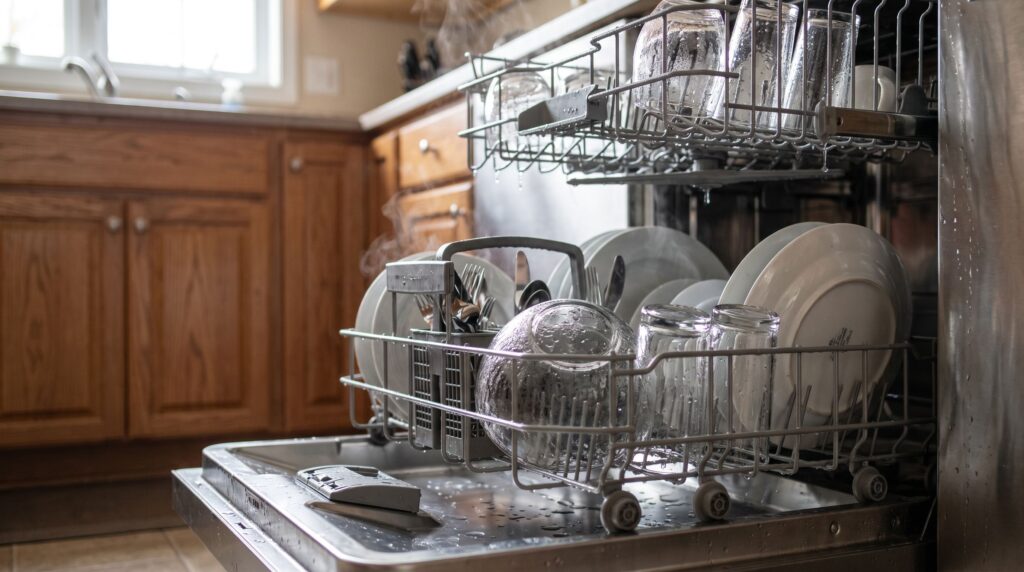
Your dishwasher runs a full cycle, you open the door — and the dishes are still wet. Plastic containers are dripping, glasses are spotted, and bowls have puddles in them. This is one of the most common dishwasher complaints, and it has a specific set of causes that are almost always diagnosable and fixable without replacing the appliance.
This guide covers every reason dishes come out wet, starting with the simplest fixes. Tricity Repairs serves Coquitlam, Port Coquitlam, and Port Moody for all dishwasher repairs.
Why Plastics Are Always Wetter Than Glass and Ceramic
Before diagnosing a problem, it’s worth knowing that plastics will almost always be wetter than glass and ceramic after a dishwasher cycle. Plastic doesn’t retain heat, so it can’t use the residual heat of the drying phase to evaporate water the way ceramic and glass do. Some residual moisture on plastics is normal. If glass and ceramic items are also consistently wet, the dishwasher has a drying problem worth investigating.
Common Causes of Poor Dishwasher Drying
1. Empty or Depleted Rinse Aid Dispenser
Rinse aid is not optional — it’s a critical part of the drying process. Rinse aid reduces the surface tension of water, causing it to sheet off dishes rather than bead into droplets. Without it, water sits on surfaces and doesn’t evaporate efficiently during the drying phase. Check the rinse aid dispenser (usually next to the detergent compartment) and refill if empty. This single fix resolves the problem for a large percentage of drying complaints. For more dishwasher tips, see: Dishwasher Drying Tricks That Actually Work.
2. Failed Heating Element
Most dishwashers use a heating element at the base of the tub to heat water during the wash cycle and to heat the air during the drying phase. When this element fails, the dishwasher cleans with cold or lukewarm water and provides no heated air for drying — resulting in wet dishes every cycle. You can test the heating element visually (look for cracks or burn marks) and with a multimeter for continuity. No continuity means the element has failed and needs replacement.
Some newer dishwashers use a condensation drying system with no heating element — instead relying on the hot final rinse water to heat dishes so condensation forms on the stainless steel walls and drains away. These models dry less aggressively than heated-dry models, and the absence of a heating element is by design.
3. Vent Fan Motor Failure
Many dishwashers have a vent that opens near the end of the cycle to release steam, combined with a fan that blows dry air across the dishes. If the vent is stuck closed or the fan motor has failed, humid air is trapped inside and dishes can’t dry properly. You can often hear the vent fan running at the end of a cycle — if it’s absent, the fan may have failed.
4. Incorrect Loading
Bowls and cups loaded face-up trap water rather than allowing it to drain. Dishes loaded too close together block airflow between surfaces. Nested spoons and forks hold water in their concave surfaces. Loading dishes at an angle so water drains away — and ensuring adequate spacing between items — makes a significant difference to drying results even with a fully functional dishwasher.
5. Wrong Wash Cycle or Settings
Economy, quick, or half-load cycles often skip or shorten the heated drying phase to save energy. If you’ve been using a shorter cycle, switch to a normal or “heavy” cycle with heated dry enabled. Many dishwashers require heated dry to be selected separately as an option — it’s not always on by default.
6. Water Temperature Too Low
The dishwasher relies on the residual heat of the final hot rinse to drive the drying process. If the incoming water isn’t hot enough (should reach 49–60°C / 120–140°F), the dishes won’t retain enough heat for effective drying. Run your kitchen hot water tap until the water is hot before starting the dishwasher to ensure the first fill is already at temperature. For related issues, see: Why Your Dishwasher Leaves White Film on Glasses.
When Professional Repair Is Needed
If rinse aid is full, loading is correct, and the heated dry option is enabled but dishes are still wet, the heating element or vent fan motor likely needs testing and replacement. Tricity Repairs serves Coquitlam, Port Coquitlam, and Port Moody — call us at (604) 359-5952 for dishwasher diagnosis and repair. Also see: Dishwasher Not Draining? Troubleshooting Guide.
Summary
Dishes coming out wet is most often caused by an empty rinse aid dispenser, a failed heating element, or a stuck vent. Start with rinse aid — refilling it costs nothing and immediately improves drying. If that doesn’t help, check that the heated dry setting is enabled and the cycle is long enough. Persistent drying problems after these steps point to a failed heating element or vent fan motor.