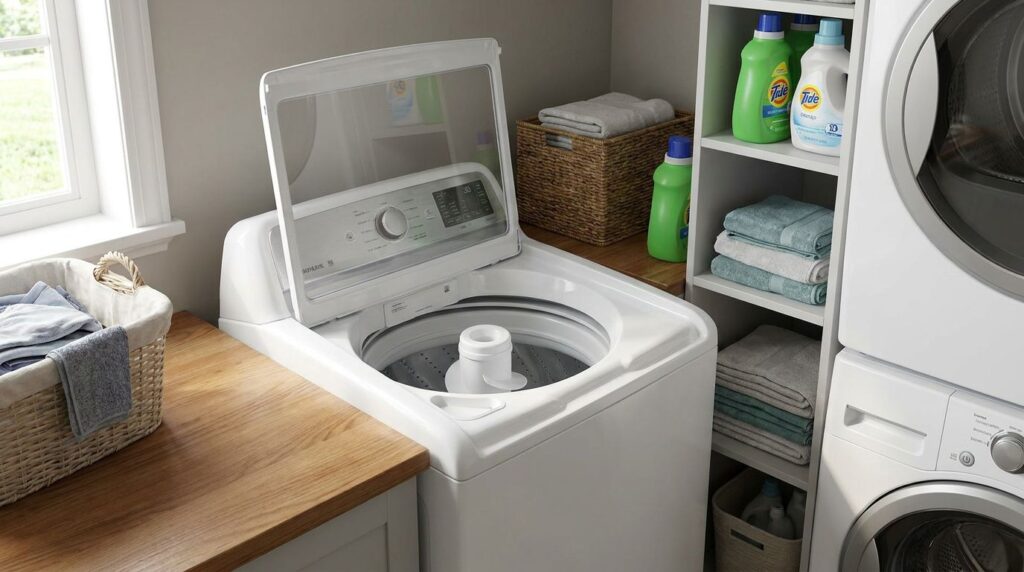
You load the washer, start a cycle, and come back to find clothes sitting in water — wet but completely unwashed. The machine filled, but the drum never moved. A washing machine that won’t agitate is one of those problems that makes itself known clearly, but the cause can come from several different directions. The agitator (on top-loaders) or the drum rotation during the wash phase (on front-loaders) is what does the actual cleaning work — without it, you just have a tub of soapy water.
This guide covers every reason a washing machine stops agitating, how to narrow down which one you’re dealing with, and what to do about it. If you’re in Coquitlam, Port Coquitlam, or Port Moody, Tricity Repairs can diagnose and fix washer problems quickly.
How Agitation Works
On traditional top-load washers, a central agitator post twists back and forth to move clothes through the water. On high-efficiency top-loaders and all front-loaders, the drum itself rotates during the wash phase — tumbling rather than twisting. In both cases, the drive motor, transmission (on older machines), or direct-drive system powers this movement.
If the drum spins freely during the spin cycle but doesn’t move during wash, the problem is usually specific to the agitation mechanism rather than the motor itself.
Common Causes of a Washer That Won’t Agitate
1. Worn or Broken Agitator Dogs (Top-Loaders)
Inside the agitator of many top-load washers are small plastic components called agitator dogs (or cogs). These allow the agitator to ratchet in one direction during the wash and engage fully during the rinse. When they wear out — which is common after years of heavy use — the agitator either spins freely in both directions without grabbing, or barely moves at all.
To test: try to move the agitator by hand. If it turns freely in both directions with no resistance, the dogs are likely worn. Agitator dogs are inexpensive and relatively easy to replace — the agitator top cap usually lifts or unscrews off to access them.
2. Broken Drive Belt
On belt-driven top-load washers, a rubber drive belt connects the motor to the transmission and agitator. A snapped or worn belt will prevent agitation entirely, though the motor may still hum. Unlike dryers, the belt on a washer is often harder to access — it typically requires removing the cabinet — but it’s a straightforward and affordable repair once accessed.
3. Failed Drive Motor or Motor Coupler
The drive motor powers everything. If it fails, neither agitation nor spinning works. However, if only agitation is affected and spin still works, the motor itself is usually fine. Many direct-drive washers use a motor coupler — a small plastic and rubber component that connects the motor to the transmission. When the coupler fails, the motor runs but power isn’t transmitted to the agitator. Coupler replacement is one of the most common washer repairs and is very affordable.
4. Faulty Lid Switch (Top-Loaders)
The lid switch must confirm the lid is closed before the wash cycle will begin agitation. A failed lid switch can allow the machine to fill with water but then prevent the motor from engaging. If you press start and hear the motor start briefly then stop, or if the machine just sits with water in it and does nothing, the lid switch may be failing.
For more on lid switch issues, see: Washing Machine Lid Lock Not Working? Here’s How to Diagnose and Fix It.
5. Transmission Failure (Older Top-Loaders)
Older top-load washers use a transmission to convert motor rotation into the back-and-forth motion of the agitator. When the transmission fails, agitation stops while the machine can still fill and drain. Signs of a failing transmission include a grinding or clunking sound during what should be the agitation phase, or the agitator moving sluggishly before stopping entirely. Transmission replacement is a more involved repair — on an older machine, it’s worth comparing repair cost to replacement value.
6. Control Board Fault (Electronic Models)
On electronically controlled washers, the control board manages which motor functions activate during each cycle phase. A failing board can skip or interrupt the agitation phase while allowing fill and drain to work normally. This is typically diagnosed after ruling out all mechanical causes — it’s usually accompanied by error codes or erratic behaviour across multiple cycles.
7. Overloaded Drum
An extremely overloaded washer can physically prevent the agitator from moving through the packed clothing. Remove half the load and try again. If agitation resumes with a lighter load, overloading is the issue and you simply need to run smaller loads going forward.
Front-Loader Won’t Tumble During Wash
On front-load washers, the wash phase involves slow drum rotation (tumbling) rather than agitation. If the drum doesn’t rotate during the wash but does spin at high speed during the spin phase, the issue is typically:
- A worn motor brushes (on brush-motor models) that fail at low speeds but work at high spin speeds
- A faulty control board not sending the correct speed signal for the wash phase
- A worn drum bearing creating so much resistance the motor can’t turn the drum slowly
Step-by-Step Diagnosis
- Check the lid switch — does it click when you press it? Does the machine advance past fill?
- Test the agitator by hand (unplugged) — does it move freely in both directions? Worn dogs suspected.
- Listen when starting the cycle — motor humming but no movement = coupler, belt, or transmission. Silence = lid switch, motor, or control board.
- Check for error codes — consult the manual for your model.
- Try a smaller load — rule out overloading.
For related washer troubleshooting, see: Why Your Washing Machine Won’t Spin: 6 Common Causes and Quick Fixes.
When to Call a Professional
Agitator dog replacement and motor coupler replacement are manageable DIY repairs with basic tools. Belt replacement and transmission work are more involved. If the diagnosis points to the control board or motor, professional testing is the most efficient path forward.
Tricity Repairs serves Coquitlam, Port Coquitlam, and Port Moody with expert washing machine repair. We carry parts for all major brands including Samsung, LG, Whirlpool, Maytag, and GE. Call us at (604) 359-5952 and we’ll have your washer agitating again quickly. For help deciding whether to repair or replace, see: Repair vs. Replace: Appliance Cost Guide.
Summary
A washing machine that won’t agitate is most commonly caused by worn agitator dogs, a failed motor coupler, a broken drive belt, or a faulty lid switch. Start with the quick manual tests — check the agitator by hand, listen for motor sounds, and check for error codes. Most of these repairs are affordable and restore full agitation performance immediately.